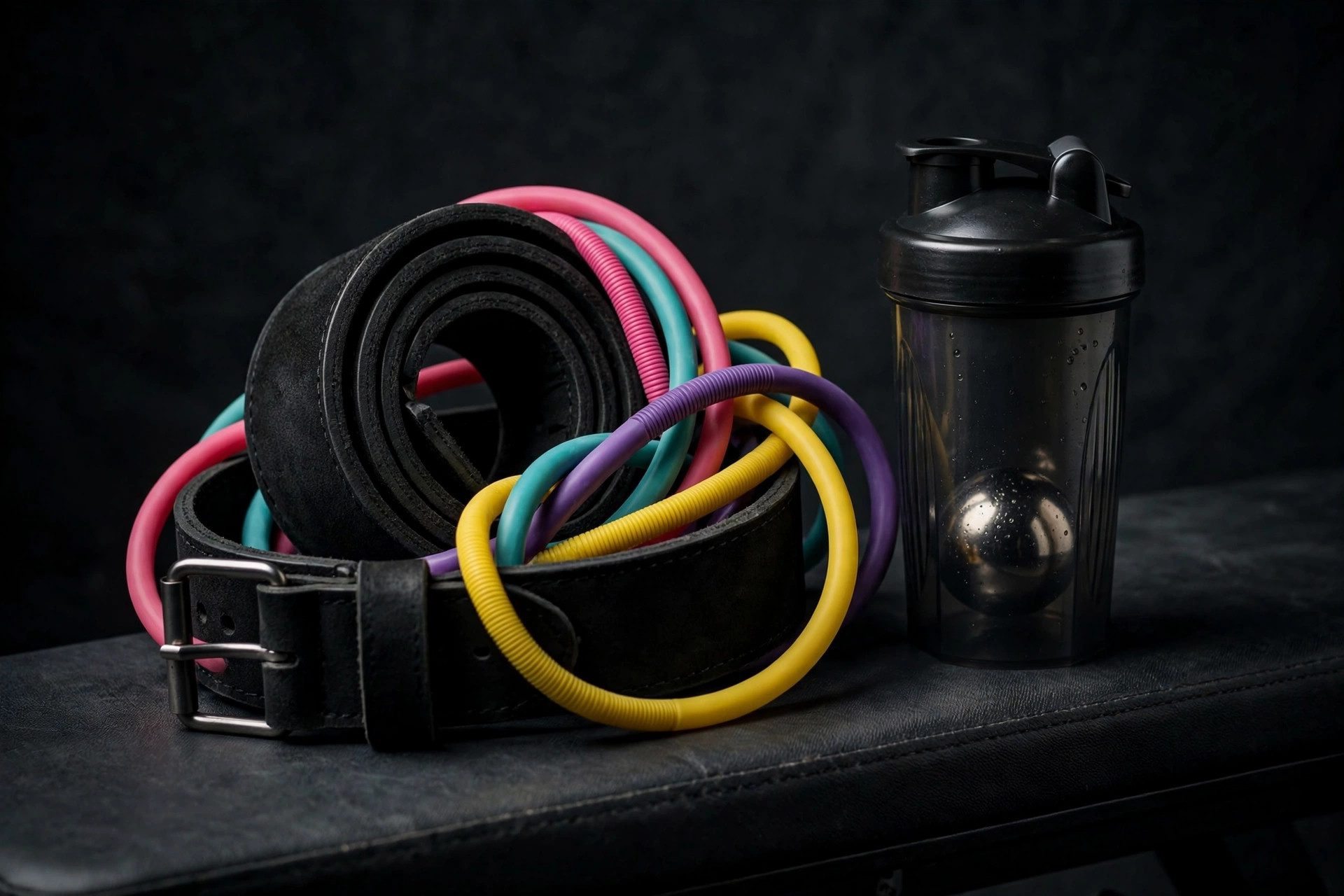
You do not need to spend much to meaningfully upgrade your training. Six pieces of gear — resistance bands, a jump rope, a shaker bottle, lifting straps, microfiber towels, and a foam roller or lacrosse ball — each cost well under $50 and each solves a real, recurring problem. Here is why each one earns its price, and what cheap gear is still a waste of money.
Resistance bands and a jump rope: the portable gym
Resistance bands are the highest value-per-dollar item in fitness. A set of loop bands costs little, weighs nothing, and covers warm-ups, glute activation, assisted pull-ups, mobility work, and full workouts when you cannot get to a gym. Buy a set with multiple resistance levels rather than a single band — you will outgrow one band in weeks but a set lasts years. Check that the bands are layered latex (smoother stretch, more durable) rather than cheap molded tubes with plastic handles, which snap at the joints.
A jump rope is the cheapest conditioning tool that exists. Ten minutes of intervals replaces a treadmill warm-up, and a decent rope with adjustable length and ball-bearing handles turns smoothly instead of fighting you. Skip the weighted or “smart” ropes at this price point — a plain speed rope with comfortable handles does the job. Size it by standing on the middle of the rope: the handles should reach your armpits.
Honest limit: bands are not a replacement for progressive barbell training — the resistance curve is uneven and you cannot load them precisely. They are a supplement and a travel solution, and at the price, that is more than enough.
A shaker bottle and microfiber towels: small habits, big payoffs
A shaker bottle seems too boring to recommend, but a good one changes behavior: if your protein shake is easy to make and easy to carry, you actually drink it. What makes one “good” is unglamorous — a leak-proof lid, a mixing mechanism that actually breaks up powder (wire ball or built-in grid), and a wide mouth you can fit a hand into for cleaning. Cheap bottles fail at exactly these three things: they leak in your bag, leave clumps, and grow science experiments in the corners.
Microfiber towels beat cotton for gym use on every axis: they absorb more, dry faster, pack smaller, and don’t go musty as quickly. Keep two — one for equipment wipe-downs, one for your face and neck. At a few dollars each, replacing them yearly is painless, and a fresh towel is one of those small upgrades that makes every session slightly better.
Lifting straps, a foam roller, and a lacrosse ball: cheap fixes for real problems
Lifting straps solve a specific problem: your grip gives out before your back or legs do on deadlifts, rows, and shrugs. A pair of basic cotton or nylon straps costs very little and lasts for years. They are a tool for overloading the target muscles on heavy pulling days — not a substitute for training your grip, which is why you should not strap up for every set. (See our lifting accessories guide for the full breakdown.)
A foam roller earns its keep as a warm-up and recovery tool. Five minutes of rolling before leg day genuinely improves how the session feels for most people. A firm, high-density roller works better than the soft decorative kind — it should not collapse under your body weight. The 18-inch length handles back and legs; the shorter 12-inch versions travel better.
A lacrosse ball is the foam roller’s precision instrument: glutes, pecs, upper back, and feet — anywhere a roller is too broad. It costs almost nothing, fits in a gym bag pocket, and lasts essentially forever. If you buy only one recovery item, make it this one.
Honest limit: none of this is a substitute for sleep, sensible programming, or addressing actual pain with a professional. Recovery tools make you feel better; they do not fix injuries.
What to skip even when it is cheap
Low price does not make something a good buy. Three categories to avoid:
Gimmicky ab gadgets. The ab roller is legitimate (and cheap); the electric ab belts, “6-minute abs” contraptions, and anything promising spot reduction are not. You cannot target belly fat with a gadget, and the infomercial-grade build quality means they break within months.
No-name heart-rate straps and trackers with bad apps. A $15 heart-rate strap sounds great until the app crashes, the battery door strips, and your data goes nowhere. Inaccurate or unreliable tracking data is worse than no data — it misleads you. If you want heart-rate data, buy from a brand with a real app and real support, even at the budget end.
Ultra-cheap lifting belts and knee sleeves. A flimsy belt that folds under load teaches you nothing and supports nothing. Budget accessories are fine when the failure mode is annoyance (a towel, a rope); when the failure mode is your spine under a loaded barbell, spend the money or skip the accessory.
What this guide does not cover
This guide covers small accessories, not major equipment — it does not review benches, racks, barbells, or cardio machines, where the price-to-quality math is completely different. It is also not medical advice: if you are dealing with persistent pain, buy the lacrosse ball by all means, but see a physical therapist or qualified professional about the underlying issue rather than trying to roll it away indefinitely.
Frequently asked questions
What is the single best gym purchase under $25?
A set of resistance bands. Nothing else under $25 covers warm-ups, mobility, assistance work, and full travel workouts in one purchase.
Are cheap resistance bands safe?
Mostly, yes, with two precautions: inspect them for nicks and tears before each use (a damaged band can snap), and never stretch them toward your face. Replace any band that shows surface cracking or thinning.
How long does budget gym gear last?
Bands: 1–3 years depending on use and sun exposure. Jump ropes: years — there is almost nothing to break. Shaker bottles: 1–2 years before lids wear out. Straps, rollers, and lacrosse balls: effectively indefinite.
Should beginners buy lifting straps right away?
Not immediately. Spend your first few months building natural grip strength on lighter weights. Straps become useful when your grip genuinely limits your pulling lifts — usually once deadlifts get heavy.