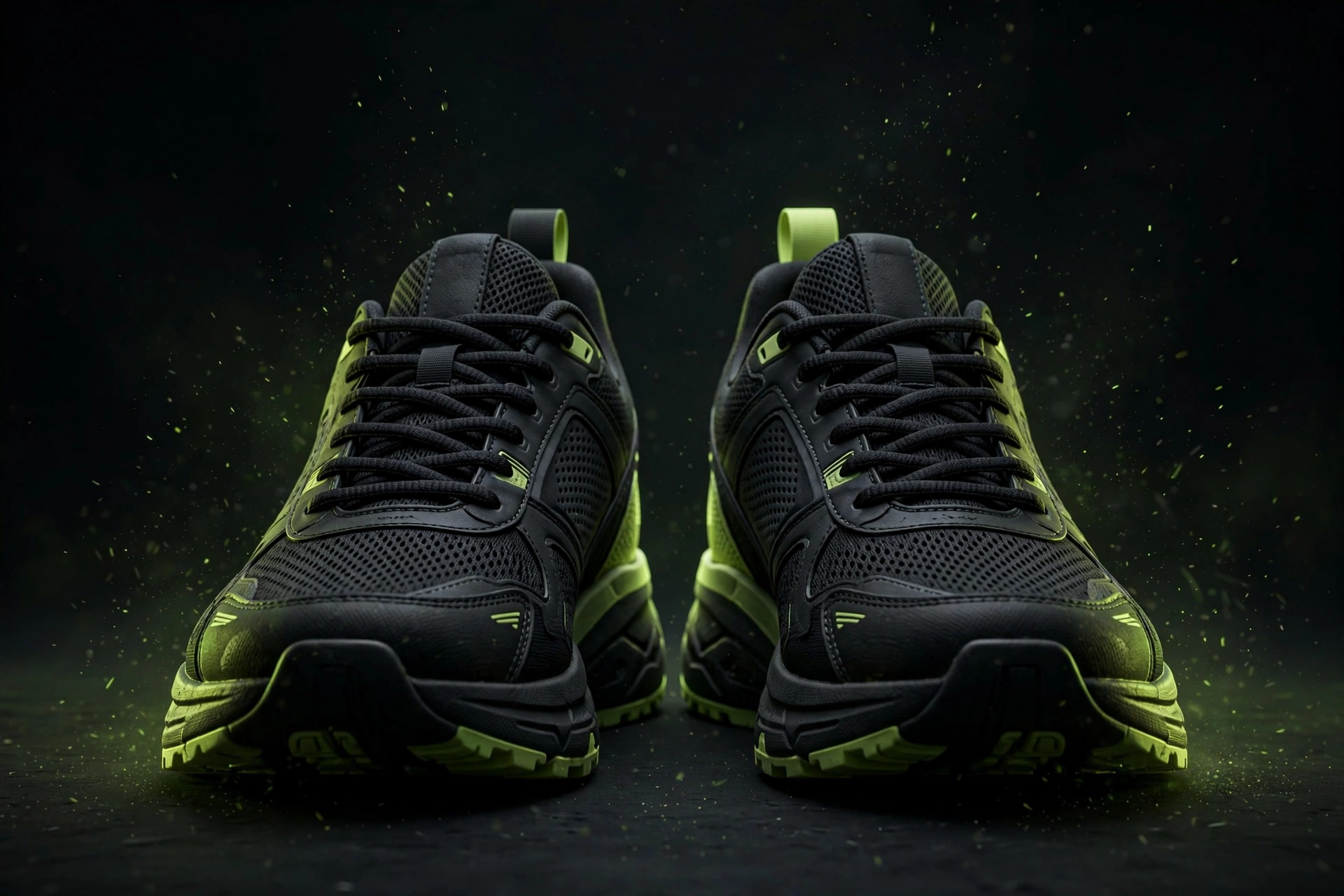
Your shoes are the foundation of every lift and every run, and the shoe that’s perfect for one is mediocre at the other. This guide explains why heel drop and sole stiffness matter for squats and deadlifts, why cushioning matters for running, why one pair can’t do both jobs well, and how to pick footwear for your actual training split — including when a single cross-trainer is enough and when two pairs genuinely make sense.
Why your shoe matters more than you think
Every force your body produces on the floor travels through your shoe, and every force the floor returns travels back up through it. A soft, squishy sole absorbs energy that should be driving the bar upward — like trying to deadlift while standing on a mattress. A hard, flat sole returns that energy and gives you a stable platform to push against. For running, the physics flip: each footstrike lands with multiples of your bodyweight, and cushioning exists to spread that impact out over milliseconds instead of microseconds. Same foot, opposite jobs.
The spec that captures the biggest difference is heel drop — the height difference between the heel and the forefoot inside the shoe. Traditional running shoes often have 8–12mm of drop, tilting you forward and adding cushion under the heel. Dedicated lifting shoes are nearly flat (0–4mm drop) so your weight stays centered over your mid-foot. Wearing high-drop cushioned shoes for heavy squats pushes your knees forward and your balance off-center, which is why they feel “tippy” under a loaded bar.
Lifting days: flat soles, stiff midsoles, stable heels
For squats, deadlifts, presses, and Olympic lifts, you want a shoe that behaves like a solid plank: thin, flat, and uncompressible. Classic flat-sole canvas shoes have served lifters for decades for exactly this reason — there’s almost nothing between your foot and the floor, so nothing shifts under load. Dedicated weightlifting shoes add a hard elevated heel (usually around 20mm) that helps ankle mobility in deep squats, worthwhile if you struggle to hit depth.
Try this test on any shoe you’re considering: press your thumb hard into the midsole at the heel. If your thumb sinks in easily, that’s energy you’ll lose under a barbell. Twist the shoe lengthwise — if it wrings out like a towel, it won’t brace your foot laterally during a split jerk or a lateral sled push. A good lifting shoe barely twists and barely compresses. You don’t need to spend a fortune here; stability is a property of the sole, not the logo.
Cardio days: cushioning, rocker geometry, and fit
For treadmill runs, stair climbs, and long rowing or cycling sessions, cushioning is your friend. A well-cushioned trainer absorbs impact, a slight rocker shape rolls you through each stride efficiently, and a breathable upper keeps heat down over 45 minutes of cardio. This is the one arena where your everyday running shoe — the thing most gym-goers already own — is genuinely the right tool.
Fit matters more for cardio than for lifting because your feet swell and your toes splay with each impact. Leave about a thumbnail’s width between your longest toe and the front of the shoe, and make sure the heel collar locks your heel in without slipping — blisters come from movement, not tightness. Treat your cardio shoe as a consumable: midsoles break down with mileage. When the shoe looks fine but your shins start complaining, the cushioning is done.
Cross-trainers: the honest compromise
Cross-training shoes exist for the person who does a bit of everything — a circuit class, a moderate lift, a short run, some rowing. They split the difference: flatter and more stable than running shoes, more cushioned than lifting shoes, with a wider base for lateral movements. For general fitness sessions where no single movement is maximal, a good cross-trainer is the right single pair.
But compromise is the key word. A cross-trainer will never match a dedicated lifting shoe under a near-maximal squat, and it will never match a running shoe on a 10K. Think of it as a Swiss Army knife: excellent to carry, worse than a real screwdriver at being a screwdriver. If your training is mostly classes, circuits, and moderate weights with occasional short cardio, one quality cross-trainer is all you need — and that describes the majority of gym-goers honestly.
When two pairs are actually worth it
The case for owning both a lifting shoe and a running shoe is simple: your training genuinely splits into heavy strength days and real cardio days. If you squat heavy on Monday and run intervals on Tuesday, switching shoes lets each session perform at its best and extends the life of both pairs — running shoes last longer when they’re not being crushed under barbells, and lifting shoes last years when they only see the platform. Cost-wise, two mid-range pairs often outlast and outperform one premium pair doing double duty.
A practical rule of thumb: if you’re lifting more than about your bodyweight for reps, or running more than about 30 minutes at a time, specialized shoes start paying for themselves. Below those thresholds, a good cross-trainer covers everything. Don’t buy two pairs because a guide told you to — buy two pairs when your training has two distinct jobs that one shoe does badly.
What this guide does not cover
This guide addresses footwear, not feet. It does not diagnose foot conditions — plantar fasciitis, bunions, pronation issues, or chronic knee pain linked to gait are reasons to see a podiatrist or physical therapist, not to shop harder. It also doesn’t cover barefoot or minimalist training, Olympic weightlifting technique, or specialty shoes for strongman and powerlifting competition (squat shoes with metatarsal straps, deadlift slippers, and the like are a deeper rabbit hole). If you have an injury or a medical condition affecting how you move, get professional guidance before changing footwear.
Frequently asked questions
Can I just lift in my running shoes?
For light warm-up weights it’s harmless. But cushioned soles compress and shift under heavy loads, which wastes force and feels unstable — switch to something flat once the weights get serious.
Are expensive lifting shoes worth it for beginners?
Not at first. A cheap flat-sole shoe gives you 90% of the benefit. Upgrade to a dedicated weightlifting shoe once you’re squatting consistently and ankle mobility, not shoe choice, is your limiting factor.
How should cross-trainers fit compared to running shoes?
Snugger. Cross-trainers should lock your foot down for lateral moves and lifts, while running shoes need a little extra toe room for impact spread. If a cross-trainer feels like a running shoe, it’ll probably lift like one too.
Can I wear gym shoes as everyday sneakers?
Lifting shoes will wreck your feet on long walks (they’re stiff by design), and wearing out your running shoes’ cushioning on errands shortens their training life. If you train regularly, keep the gym shoes for the gym.