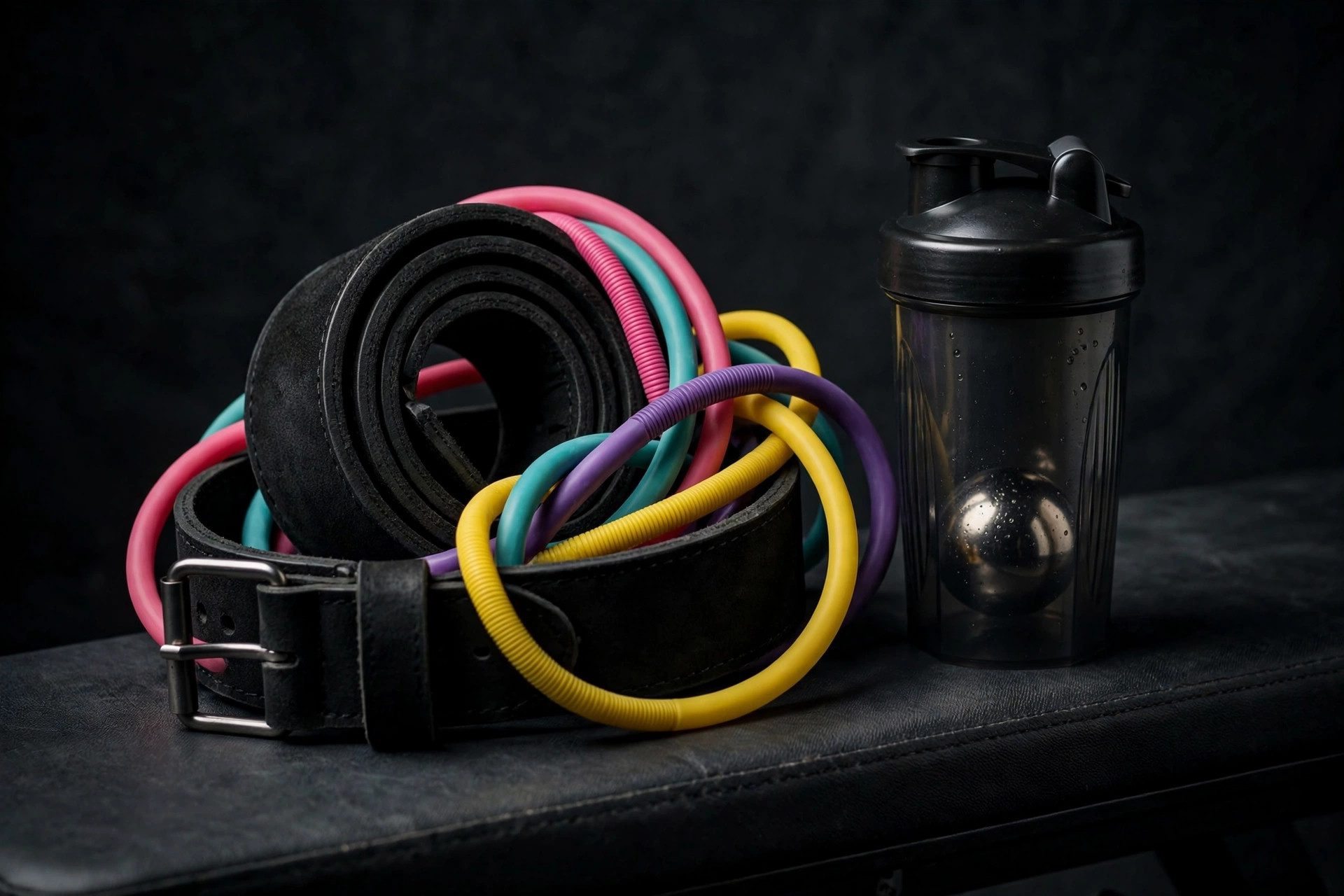
Belts, straps, wraps, and grips all do real jobs — and all of them can become crutches that hide weak links in your training. This guide explains when each accessory genuinely helps, how to size and choose it, and the “earn it first” principle that keeps accessories working for you instead of against you.
Belts: when they help, how to size them, lever vs prong
A lifting belt does not “protect your back” by itself. What it does is give your core something to brace against: you push your abs out into the belt, intra-abdominal pressure rises, and your torso becomes a stiffer column under a heavy barbell. That is genuinely useful on heavy squats, deadlifts, overhead presses, and rows — roughly, sets where bracing is the limiting factor.
When to use one: your heaviest working sets — typically the top sets of compound lifts, not warm-ups and not every accessory exercise. If you belt up for a light set of curls, the belt is a fashion item.
Sizing: measure around your waist where the belt will sit (usually over your navel, not your pant size) and follow the manufacturer’s chart. It should be snug enough to brace against but loose enough for a full breath.
Lever vs prong: lever belts lock with a lever — fast on and off with consistent tightness, but resizing needs a screwdriver. Prong belts adjust in seconds but take longer to get on and off. Pick lever if your size is stable, prong if it fluctuates or you share equipment. Leather belts are stiffer and last decades; nylon is cheaper and more flexible.
Straps: a tool for heavy pulls, not a grip replacement
Lifting straps wrap around the bar and your wrist so your grip is no longer the limiting factor on deadlifts, rows, shrugs, and pull-up variations. Used correctly, they let you overload the target muscles — your back and posterior chain — past the point where your hands would give out.
The crutch problem is real: if you strap up for every pulling set from day one, your grip never develops. The standard practice is to do warm-ups and lighter sets strapless, and bring the straps out only for the heaviest working sets where grip is genuinely the limiter.
Basic cotton or lasso straps are all most lifters need. And straps do not fix a bad deadlift setup: if the bar is rolling out of your hands because your technique is off, fix the technique first.
Wrist wraps, knee sleeves, and knee wraps: what each one does
These three get confused constantly, and they do different jobs.
Wrist wraps stabilize the wrist joint under load — useful for heavy pressing (bench, overhead press) where the wrist wants to bend back. They are support, not strength: wrap for your heavy sets, not for the whole workout, and keep training wrist stability with unwrapped lighter work.
Knee sleeves (usually neoprene) provide warmth, compression, and a mild rebound out of the bottom of a squat. They do not add much weight to your lift; their real value is joint comfort and warmth, especially for lifters with cranky knees or cold gyms. Sizing matters — too tight and they cut circulation, too loose and they slide down mid-set.
Knee wraps (elastic, wrapped in a spiral) are a different animal: they store elastic energy and can add real pounds to a squat. They belong to competitive powerlifting, not general training. If you are not competing in a federation that allows wraps, you almost certainly do not need them.
None of these fix pain. If a joint hurts under load consistently, see a physical therapist or sports-medicine professional — that is not a shopping decision.
Chalk, liquid chalk, and gym policies
Chalk — magnesium carbonate — improves grip by drying sweat and increasing friction on the bar. For heavy deadlifts and any pulling in a humid gym, it is the single most effective grip aid there is, and it is cheap.
The catch is gym policy: many commercial gyms ban loose block chalk because of the mess. Check the rules before you buy. The workarounds, in order of gym-friendliness:
- Liquid chalk: alcohol-based, dries in seconds, almost no dust. Accepted almost everywhere block chalk is banned. The downside: less effective for very sweaty hands and needs reapplying more often.
- Chalk balls / sock chalk: a mesh ball filled with chalk that dispenses less mess than a loose block. A middle ground — some gyms allow it, some don’t.
- Grip paste or rosin: niche products that some lifters prefer for the lack of dust; check policy first.
Whatever you use, keep it off the floor and benches — nothing gets chalk banned faster than lifters who treat the gym like a construction site.
The “earn it first” principle
The through-line of this whole guide: accessories should extend strength you already have, not substitute for strength you never built. Lift beltless until your bracing limits your heavy sets. Pull strapless until your grip limits your deadlift. Press unwrapped until your wrists limit your bench.
A reasonable rule of thumb: if you cannot explain exactly which problem the accessory solves for you, you do not need it yet. “My grip fails on the last two reps of heavy rows” is a strap problem. “Everyone at the gym wears a belt” is not a belt problem.
What this guide does not cover
This guide does not teach lifting technique — no article can replace a qualified coach watching your squat and deadlift in person. It does not cover competition equipment rules (powerlifting federations have specific approved-gear lists; check yours before buying for a meet). And it is not medical advice: persistent joint or back pain under load deserves a physical therapist or sports-medicine professional, not a new accessory.
Frequently asked questions
Should beginners buy a lifting belt?
Not at first. Learn to brace your core without one — the belt amplifies a brace you can already do, it does not create one. Add a belt when heavy compound sets are limited by bracing, not before.
Lever or prong belt — which is better?
Neither. Lever belts are faster with consistent tightness; prong belts adjust in seconds without tools. Pick lever if your size is stable, prong if it fluctuates or you share the belt.
Do lifting straps make your grip weaker?
Only if you overuse them. Straps used for heavy top sets, with grip trained on warm-ups and accessory work, do not meaningfully weaken it. Straps used for everything, from day one, absolutely do.
Can I use chalk at a commercial gym?
Usually not loose block chalk — most chains ban it. Liquid chalk is accepted at the vast majority of gyms. Check your gym’s posted policy or ask the staff before you buy.