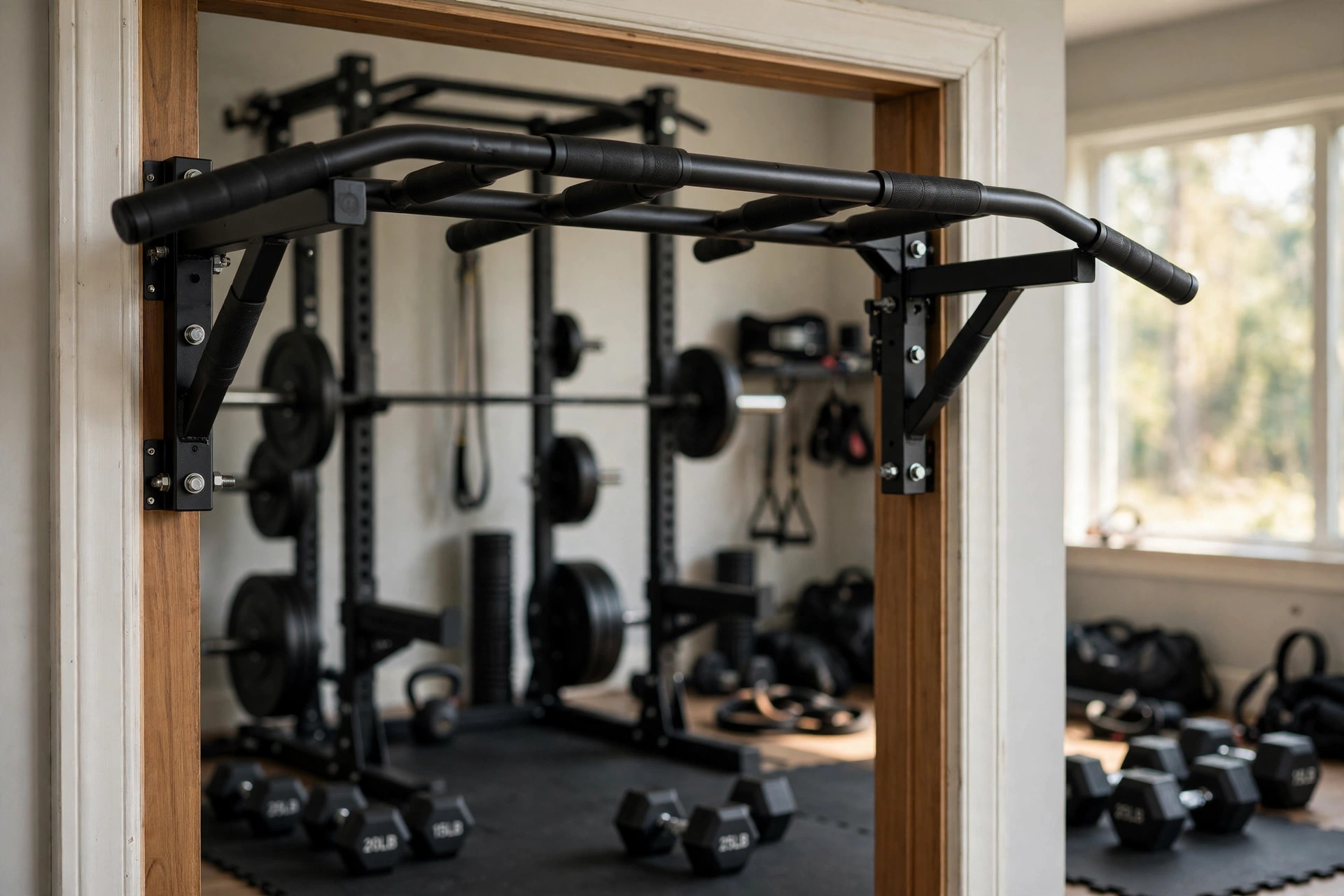
The pull-up is the one upper-body exercise a home gym cannot fake — and the bar is the whole purchase. In 2026 the choice is not really about brands; it is about how the bar attaches to your house. Doorway, wall, ceiling, freestanding, or budget: each mounting style has a home it suits and a failure mode to avoid. This guide explains the five styles honestly — including how to measure your doorway before ordering — and picks the bar worth buying in each.
Last updated: October 20, 2026 · Prices and availability checked October 2026.
Gym Gear Dialed is reader-supported. When you buy through links on our site, we may earn an affiliate commission. Learn more
Measure before you buy: the 60-second doorway check
Most returns in this category are not defects — they are doorways. Before ordering any doorway bar, check four things. Width: measure inside the frame; most leverage bars fit roughly 24–36 inches. Trim: leverage bars press their pads against the trim and wall above the door — you want solid wood trim at least about a half-inch proud of the wall, not hollow decorative molding. Depth: the wall-plus-trim thickness must fall in the bar's stated range so the frame can hook properly. Headroom and swing: stand in the doorway, reach up, and picture your chin clearing the bar with knees bent — and check what is behind you, because you will step back off this thing tired, a thousand times.
If the doorway fails any check, do not force it — that is exactly what the wall, ceiling, and freestanding picks below exist for.
The grips, explained once
Wide overhand is the classic pull-up: lats and upper back, hardest on the shoulders at the bottom. Neutral grip (palms facing each other on parallel handles) splits the work with the biceps and brachialis and is the friendliest position for sore shoulders and elbows — if your joints complain about straight-bar work, neutral grips alone justify the multi-grip picks. Close underhand is the chin-up: the most biceps and the easiest place for beginners to get their first full rep. A bar that offers all three keeps progressing long after a straight bar gets stale.
How we compared them
We compared pull-up bars on mounting method and what it demands of your home, stated weight capacity, grip positions offered, standoff and headroom geometry, and stability reports in owner reviews. An honest note: these are researched roundups built from manufacturer specifications and aggregated owner reviews — not load testing of every unit. Every claim below is about what a mounting style does and how to choose within it, so you can match the bar to your house first and your training second — in that order, because a bar that does not fit your doorway trains nothing.
| Product | Best for | Key spec | Price |
|---|---|---|---|
| Multi-grip doorway pull-up bar (leverage mount) | Most home gyms & renters | Leverage mount · no screws · multiple grip positions · ~300 lb ratings typical | Check price → |
| Wall-mounted pull-up bar (stud mount) | Dedicated home gyms | Lag-bolted into studs · 30–48in bar · highest stability | Check price → |
| Ceiling / joist-mounted pull-up bar | Garage gyms & tall lifters | Bolts to joists · full dead-hang height · multi-grip options | Check price → |
| Freestanding power tower | No suitable doorway or wall | Pull-up + dip + VKR stations · large footprint · no mounting | Check price → |
| Budget doorway pull-up bar under $40 | First bar & tight budgets | Tension or simple leverage bar · single straight bar · lightest duty | Check price → |
The five pull-up bars worth buying in 2026
Multi-grip doorway pull-up bar (leverage mount) Best overall
The default recommendation for a reason: a leverage-mounted doorway bar hooks over the trim, locks against the frame with your bodyweight, and comes down in seconds with no holes, no tools, and no landlord conversation. The multi-grip frame is the version worth buying — wide grips for pull-ups, parallel neutral grips that are kinder to shoulders and elbows, and a low bar position that doubles for push-ups and dips off the floor. For most people training at home, this single piece of steel covers the entire upper-body pulling menu.
Two checks decide whether it fits your home. First, measure the doorway: most bars want a frame roughly 24–36 inches wide with trim at least a half-inch deep for the pads to bite on, and hollow or decorative trim is a genuine no — the leverage that makes the bar safe also presses hard on the frame. Second, be honest about headroom: your chin has to clear the bar, so taller lifters in standard 80-inch doorways will bend their knees — normal, and fine. If your doorways pass those two checks, stop shopping and buy this category; everything below it is a specialization.
- No drilling, no damage — up and down in seconds
- Wide, neutral, and close grips plus floor push-up/dip handles
- Needs sturdy door trim of the right width — measure first
- Not for kipping or swinging movements; strict reps only
Our verdict: No drilling, no damage — up and down in seconds — the pick for most home gyms & renters.
Best for: most home gyms & renters Not ideal for: needs sturdy door trim of the right width — measure first
Wall-mounted pull-up bar (stud mount) Best permanent
If the gym is permanent, bolt the bar to the wall and never think about it again. A stud-mounted wall bar is the most rigid option short of a rack attachment: no flex, no frame pressure, no weight-limit anxiety, and enough standoff from the wall (look for 14 inches or more) to keep your knees and face clear through a full strict rep. It is also the best platform for accessories — a set of gymnastic rings or a suspension trainer hung from a rigid wall bar turns one station into rows, dips, and core work.
The requirements are real: you need two studs at the bar's bolt spacing (or a ledger board across studs), a drill, and the discipline to actually hit the studs — drywall anchors are not a mounting method for a bar you will hang your bodyweight from. Mount it high enough that your arms are fully extended at a dead hang with knees bent, or accept bent-knee reps as the price of an 8-foot ceiling. Installed correctly, this is a buy-once piece of equipment that outlives every other thing in the gym.
- Rock-solid — no flex, no door frame involved
- Best base for rings and suspension trainers
- Permanent holes; must anchor into studs
- Useless to renters who cannot drill
Our verdict: Rock-solid — no flex, no door frame involved — the pick for dedicated home gyms.
Best for: dedicated home gyms Not ideal for: permanent holes; must anchor into studs
Ceiling / joist-mounted pull-up bar Best for garages
Garage gyms have one great advantage over spare bedrooms: exposed or accessible joists overhead. A ceiling-mounted bar bolts straight into those joists and hangs the bar at true dead-hang height — tall lifters can finally do pull-ups with straight legs, and there is clearance for muscle-up practice and strict toes-to-bar without kicking a door frame. Multi-grip ceiling bars add parallel and angled handles to the same mount.
The homework is structural, not cosmetic: locate the joists with a stud finder, confirm spacing matches the mount (or span two joists with the bar's cross-members), and use the supplied lag bolts into solid wood — never into drywall alone. In a finished ceiling you will be patching two small holes per joist if you ever move, which most garage-gym owners consider a fair trade. If your power rack already has a pull-up station, this pick is redundant; if it does not, this is the most satisfying upgrade in this guide.
- Full dead-hang height — tall lifters keep straight legs
- Frees the doorway and the wall entirely
- Requires accessible, solid joists
- Fixed location — measure the swing/rep space twice
Our verdict: Full dead-hang height — tall lifters keep straight legs — the pick for garage gyms & tall lifters.
Best for: garage gyms & tall lifters Not ideal for: requires accessible, solid joists
Freestanding power tower Best no-drill
A power tower solves the problem none of the mounted bars can: no trustworthy doorway, no studs you are allowed to touch, and no joists — just floor space. In one footprint you get a pull-up bar, dip handles, a vertical knee-raise station, and usually push-up grips, which makes it the closest thing to a complete bodyweight station. Modern towers have gotten genuinely sturdy; look for wide stabilizer feet, a weight rating comfortably above your bodyweight plus a dip belt, and dip handles spaced for your shoulders.
The honest costs are space and feel. A tower claims roughly a 4-by-4-foot patch of floor forever, and even a good one has a whisper of sway on hard pull-ups that a bolted bar never has — rubber feet on gym flooring tame most of it. Buy it when mounting is truly off the table; if you can bolt anything to anything, the mounted picks above are cheaper, smaller, and more rigid.
- Pull-ups, dips, knee raises, push-ups in one station
- Zero mounting — works where nothing can be drilled
- Permanent 4x4 ft footprint
- Slight sway on aggressive reps, even on good models
Our verdict: Pull-ups, dips, knee raises, push-ups in one station — the pick for no suitable doorway or wall.
Best for: no suitable doorway or wall Not ideal for: permanent 4x4 ft footprint
Budget doorway pull-up bar under $40 Best budget
Under $40 you give up the multi-grip frame and the floor-exercise handles, and you keep the one thing that matters: a straight bar to do pull-ups on. Two styles live here — simple leverage bars with foam grips, and twist-to-tighten tension bars. Of the two, the leverage style is the safer buy: a tension bar's grip on the frame is only friction, and the internet's doorway-bar fail videos are overwhelmingly tension bars letting go mid-rep.
Respect the limits and this category is legitimately good: strict pull-ups and chin-ups at honest bodyweight, feet on the floor for assisted reps while you build up, and a towel over the bar for grip work. What it is not for: weighted pull-ups with a heavy dip belt, swinging or kipping reps, or households where the user is near the stated weight limit — step up to the multi-grip pick for any of that. As a first bar that turns a doorway into a daily habit, forty dollars is the cheapest strength program you will ever buy.
- Real pull-ups at the lowest price in this guide
- Leverage style mounts in seconds, stores in a closet
- Straight bar only — no neutral grips for cranky shoulders
- Strict reps at bodyweight only; not for weighted work
Our verdict: Real pull-ups at the lowest price in this guide — the pick for first bar & tight budgets.
Best for: first bar & tight budgets Not ideal for: straight bar only — no neutral grips for cranky shoulders
Our verdict
Most people should buy the multi-grip doorway bar — if the doorway check passes, it is the fastest, cheapest route to daily pull-ups with shoulder-friendly neutral grips. Permanent gyms should skip straight to the wall-mounted or ceiling bar and enjoy never thinking about it again. The power tower is the honest answer when nothing can be mounted, and the under-$40 bar is the right first step when budget decides. Pair whichever you choose with the adjustable dumbbells in our guide and rows stop being an excuse — between bar and bells, your back training is covered.
Getting your first pull-up (and your tenth)
The bar only works if a program hangs from it. The progression that works for almost everyone: start with dead hangs (build to 30 seconds), add slow negatives (jump or step up, lower for 5 seconds), then band-assisted or feet-assisted reps, then strict singles — greasing the groove with frequent low-fatigue sets through the day, which a doorway bar makes uniquely easy because it is always up and always on your way past. Add one rep per week and most beginners own a strict pull-up in two to three months. Chalk or a towel helps grip before it helps ego; liquid chalk keeps a home gym clean.
Frequently asked questions
Will a doorway pull-up bar damage my door frame?
A correctly fitted leverage bar can leave pad marks or compress soft trim paint — foam pads and a strip of painter's tape on contact points prevent most of it. Structural damage comes from bars fitted to trim outside their stated range or used for swinging reps. If the trim is hollow or decorative, choose a mounted or freestanding pick instead.
How much weight can a doorway bar really hold?
Quality multi-grip bars are typically rated around 250–300 lb, and the rating assumes correct fit and strict reps. Stay honest: user plus any dip-belt weight should sit comfortably under the rating, and dynamic movements belong on bolted bars only.
Doorway bar or rack pull-up station?
If you already own a rack with a pull-up bar at good height, you do not need either — use it. Doorway and wall bars win when there is no rack, when the rack is across a cold garage and the doorway is on your daily path, or when a second station keeps a training partner moving.
Are neutral grips really easier on shoulders?
For most lifters, yes — palms-facing grips keep the shoulder in a less internally rotated position at the bottom of the rep and shift some load to the arms. They are not a medical fix, but they are the first change to try when straight-bar pull-ups irritate your shoulders or elbows.