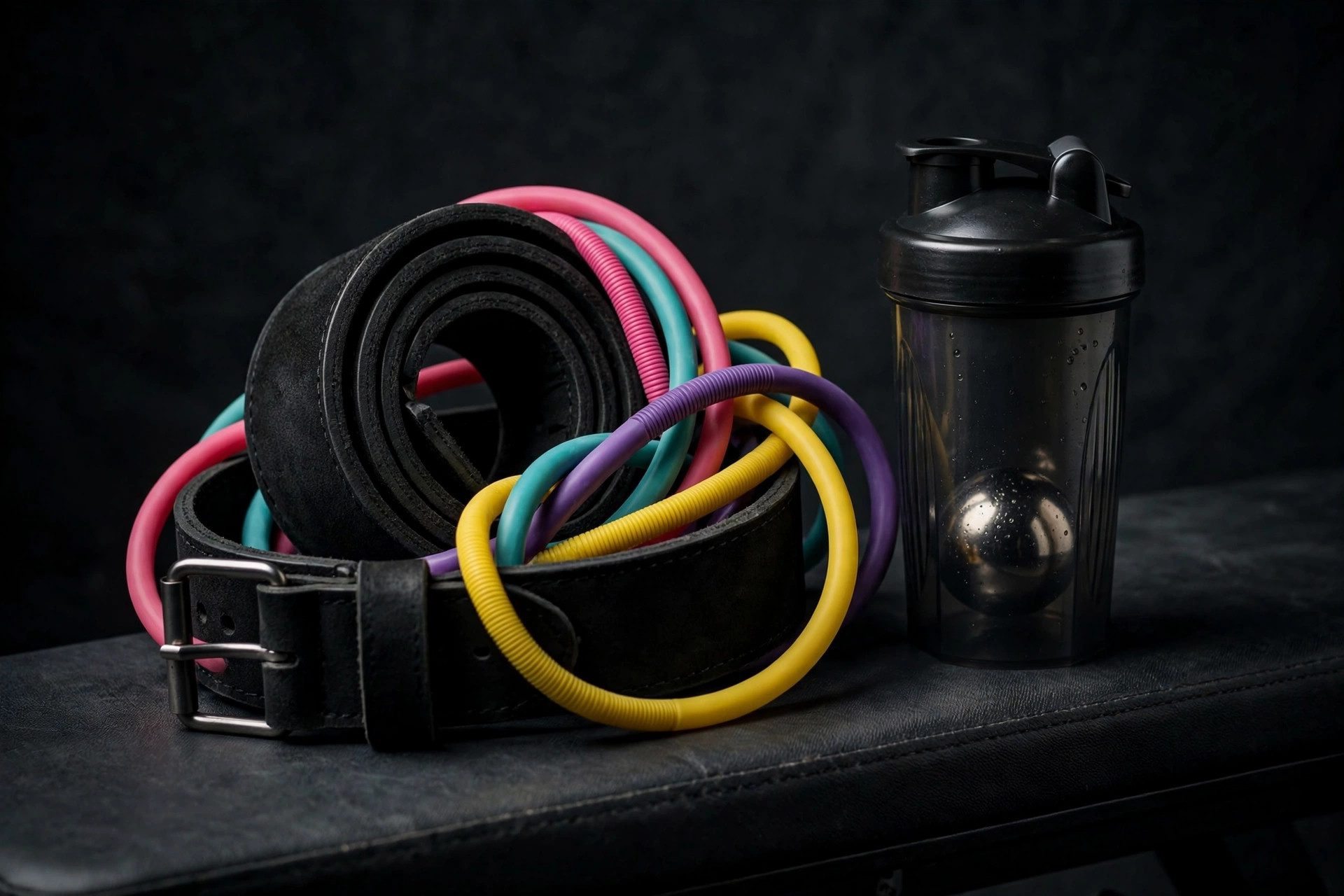
Resistance bands are the most underrated strength tool in home fitness — and the most misunderstood. Used well, they build real muscle, travel in a backpack, and cost less than a month of gym membership. Used badly, they are the flimsy tubes gathering dust in a drawer. The difference is buying the right type for your training and understanding what bands do well (and what they will never replace).
What bands actually do well — and what they don’t
Bands provide variable resistance: the band gets harder as it stretches. That means maximum tension at full contraction — the top of a press, the squeeze of a row — where free weights are often easiest. For hypertrophy (muscle growth), that is a genuinely useful stimulus, and research consistently shows bands build muscle comparably to weights when effort is matched.
What bands do poorly: heavy bilateral lower-body strength. You cannot replicate a 300-lb squat with bands — the resistance curve, the loading, and the stability demands are all wrong. Bands are a complement to heavy barbell and dumbbell work (see our adjustable dumbbell guide), not a replacement for it. They shine for upper-body hypertrophy, accessory work, warm-ups, rehab-style prehab, and training while traveling.
The other honest limitation: progression is fuzzier. Adding 5 lb to a dumbbell is precise; moving from a red band to a black band is approximate. You progress bands by feel, reps, and tempo rather than by the number on a plate — which works fine once you accept it.
The three band types, and which to buy first
Loop bands (power bands): continuous flat loops, usually 41 inches long, color-coded by thickness. These are the workhorse — anchor them to a power rack or door anchor for rows and presses, loop them for pull-up assistance, stand on them for curls and overhead presses. A set of 3–5 loop bands covers most training. Buy layered latex (multiple thin layers bonded together) over molded single-layer bands — layered bands snap less catastrophically and last far longer.
Tube bands with handles: hollow tubes with foam handles and a door anchor, sold as “home gym in a bag” sets. Great for beginners — the handles feel familiar, the door anchor enables chest presses and rows, and the whole set costs $25–$40. Downsides: the tubes are thinner than loop bands (less max resistance), the handle connections are the failure point, and serious lifters outgrow them fast. Perfect starter set; not a forever tool.
Mini bands (booty bands): small loops for around the knees or ankles — glute activation, lateral walks, warm-ups, and physical-therapy-style work. Cheap, nearly indestructible, and useful at every strength level. Fabric-covered mini bands grip better and do not roll or pinch skin like bare latex ones. Every home gym should own a set regardless of training style.
If you buy one thing: a set of layered-latex loop bands. They do 80% of what all three types do combined.
Resistance levels: decoding the colors
Band colors are not standardized — one brand’s red is another’s medium — so ignore the color and read the stated resistance range (e.g. “15–35 lb”). That range is the tension from slight stretch to near-maximum stretch; the actual resistance you feel depends on how far you stretch the band, your limb length, and where you anchor it.
Practical guidance: most adults want a set spanning roughly 10–50 lb of stated resistance. Lighter bands for warm-ups, rotator-cuff work, and high-rep finishers; heavier bands for rows, presses, and pull-up assistance. Buying a single band is a false economy — the set costs barely more and the light bands get used constantly for warm-ups even by strong lifters.
Doubling up is the progression hack: loop a band twice around an anchor to roughly double resistance, or combine two bands. It is inelegant and it works.
Safety: bands store energy, respect them
A stretched band is stored energy pointed at your face. The safety rules are short and non-negotiable:
- Inspect before every session: run the band through your hands feeling for nicks, tears, or thin spots — especially near the ends and any connection points. A nicked band is a band that snaps, and it always snaps mid-rep.
- Anchor to something immovable: a power rack upright, a closed door with a proper door anchor on the hinge side (never the handle side), or your own body weight standing on the band. Never anchor to furniture that can tip or slide.
- Keep bands away from sharp edges: rack corners, rough concrete, and jewelry all abrade latex. A door anchor’s strap exists precisely to protect the band from the door edge — use it.
- Control the release: never let a stretched band snap back toward your face. Finish the rep, then deliberately walk the tension down. Most band injuries are release injuries, not snap injuries.
- Replace on schedule: latex degrades with UV, heat, and time. Bands stored in a hot garage last 1–2 years; bands stored cool and dark last 3–5. When the latex gets sticky, discolored, or loses snap, retire it — a $30 set is not worth an eye injury.
Programming bands for real strength
Bands work best programmed like weights: 3–5 sets of 8–20 reps, taken close to failure, progressing over time. The exercises that translate best: rows (seated, bent-over, or anchored — the king band movement), presses (chest press anchored behind you, overhead press standing on the band), pull-aparts and face pulls (shoulder health, high reps), curls and pushdowns (constant tension suits arms perfectly), and pull-up assistance (loop a heavy band over the bar — the assistance is greatest at the bottom where you need it most, which is biomechanically ideal).
For lower body, bands are assistance, not the main event: goblet squats holding a heavy loop band, Romanian deadlifts standing on a band, lateral walks with a mini band, and glute bridges all work. But if leg strength is the goal, bands pair with — not replace — loaded squats and hinges.
Tempo is the intensity dial bands were made for: slow 3-second eccentrics with a 1-second squeeze turn a medium band into a serious set. When the reps get easy, slow down before you buy heavier.
What to pay and what to avoid
$20–$40: a solid set of layered-latex loop bands or a tube-with-handles starter set. This is all most people need. Below $15, the latex is thin, the handles are glued rather than crimped, and the set will not survive a year.
$40–$80: premium loop-band sets with wider bands, better layering, and honest resistance ratings, plus fabric mini-band sets. Worth it if bands are a primary training tool rather than a travel backup.
Avoid: “stackable” gimmick systems with proprietary connectors (lock-in, breakage, replacements cost more than a new set), bands with no stated resistance range, and anything marketed primarily with before-and-after photos rather than specs.
The travel kit: a full workout in a backpack
Bands’ superpower is portability — a loop-band set and a door anchor weigh under 3 lb and fit in a laptop bag. The travel workout that actually works: door-anchored rows and chest presses, standing overhead press on a loop band, Bulgarian split squats with the rear foot on a chair and a band under the front foot, banded push-ups with the band across your back, and a mini-band glute circuit. That is a genuine full-body session with no hotel gym required.
Two travel tips: pack the door anchor even if you think the hotel has a gym — hotel gyms are where bands earn their keep, filling in for the missing dumbbells between 20 and 50 lb. And bring one band heavier than you think you need; without your usual setup for reference, most people under-pack resistance and end up doing cardio with extra steps.
Frequently asked questions
Can you build muscle with just resistance bands?
Yes — for upper body and with serious effort, absolutely. Studies show comparable hypertrophy to weights when sets are taken close to failure. The practical ceiling is lower-body maximal strength and the precision of progression, which is why bands plus adjustable dumbbells is such a strong home-gym combination.
How long do resistance bands last?
Quality layered-latex bands last 2–5 years depending on storage and use. Heat, sunlight, and nicks are the killers. Inspect before each session and retire bands that get sticky, discolored, or develop thin spots — they are cheap to replace and expensive to have snap.
Are fabric bands or latex bands better?
Different jobs. Latex loop bands for strength work (rows, presses, pull-up assistance) — they stretch further and provide more resistance. Fabric mini bands for around-knee/ankle work — they grip, do not roll, and do not pinch. Own both; they cost little.
What is the safest way to anchor bands to a door?
Use a proper door anchor — a wide nylon strap with a foam stopper — placed on the hinge side of a solid, closed (and ideally locked) door. Never anchor to the handle side, never to a hollow-core door you would not trust with your body weight, and never skip the anchor and just close the band in the door — the edge will saw through latex.