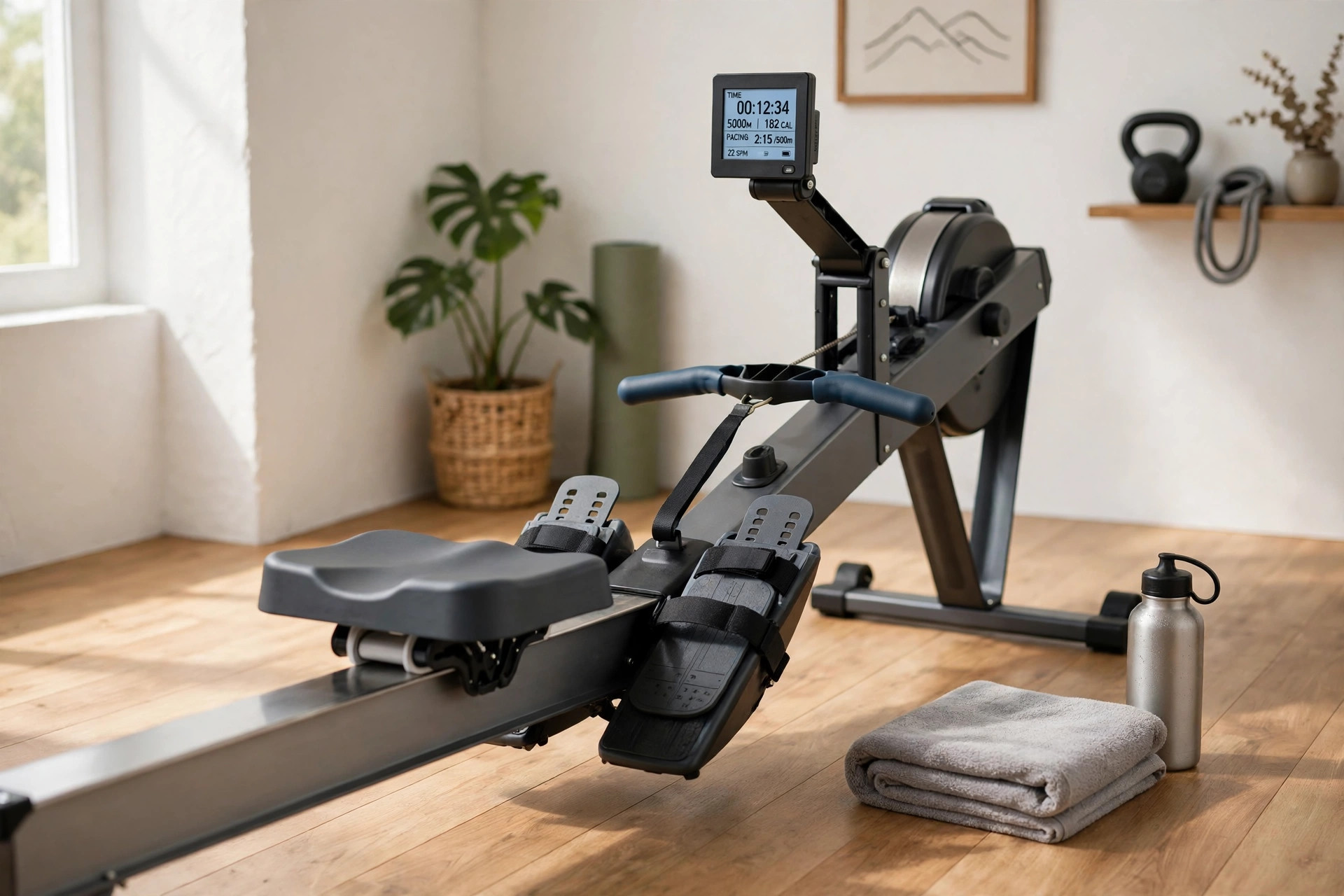
A rowing machine is the most complete cardio machine a home gym can hold: legs, back, arms, and lungs in every stroke, low impact on knees and joints, and a footprint smaller than a treadmill. In 2026 the choice under $1,000 is not really about brands; it is about resistance type — magnetic, air, water, or folding — and about the monitor, which decides whether the machine trains you or just counts strokes. This guide explains the four types honestly, the measurements that decide fit, and the five rowers worth buying under $1,000.
Last updated: November 6, 2026 · Prices and availability checked November 2026.
Gym Gear Dialed is reader-supported. When you buy through links on our site, we may earn an affiliate commission. Learn more
Resistance types, explained once
Magnetic uses magnets around a flywheel: silent, smooth, adjustable in fine steps, and consistent. Air uses a fan: the harder you pull, the more it resists — self-pacing, loud, and the benchmark for interval training. Water uses paddles in a tank: the most natural feel, a pleasant whoosh, resistance set by water level. Hydraulic (piston arms, mostly on the cheapest machines) is not in this guide: the stroke feels uneven and the arms wear. Under $1,000, magnetic is the default, air is the athlete's pick, and water is the feel pick — choose by which of those sentences sounds like you.
Measure before you buy: the 60-second fit check
Most returns in this category are fit, not defects. Check four things. Length: a full-size rower needs about 8 feet of floor in use — rail plus seat travel plus your body. Rail length vs. your height: taller rowers need longer rails; check the stated user-height limit, not just the weight limit. Ceiling: you sit low, so ceiling height is rarely the problem — storage height is, for upright-folding models. Noise tolerance: if the rower shares a wall with a bedroom, magnetic or water only; air rowers are genuinely loud at effort.
How we compared them
We compared rowers on resistance type and what it means for noise, feel, and training; monitor quality (split, watts, stroke rate, heart-rate support, app connectivity); rail length and footprint; weight capacity; and owner-reported durability. An honest note: these are researched roundups built from manufacturer specifications and aggregated owner reviews — not instrumented lab tests of every unit. Every claim below is about what a resistance type does and how to choose within it, so you can match the machine to your room and your training first.
| Product | Best for | Key spec | Price |
|---|---|---|---|
| Mid-range magnetic rower with app training (under $1,000) | Most home gyms | Magnetic resistance · quiet · 16+ levels · app-compatible monitor | Check price → |
| Air rower (fan resistance) | Serious conditioning & CrossFit-style training | Fan flywheel · self-pacing resistance · standard 500m split monitor | Check price → |
| Water rower | Low-impact training & quiet living rooms | Water tank resistance · smooth stroke · natural sound | Check price → |
| Compact folding magnetic rower | Small apartments & shared rooms | Folds upright · magnetic resistance · shorter rail | Check price → |
| Budget magnetic rower under $400 | First rowers & tight budgets | Magnetic resistance · basic monitor · lightest build | Check price → |
The five rowing machines worth buying under $1,000 in 2026
Mid-range magnetic rower with app training (under $1,000) Best overall
The default recommendation under $1,000: a magnetic rower with a proper monitor and app connectivity. Magnetic resistance is the quietest of the four types, it adjusts in fine steps instead of big jumps, and it stays consistent from the first stroke to the last — no flywheel wind-up, no water to top up, no chain noise carrying through the house at 6 a.m. The monitor matters as much as the resistance: look for a backlit display showing split time per 500 meters, strokes per minute, watts, and heart-rate compatibility, because the numbers are what turn rowing from a warm-up into a training program.
App training is the difference between a rower you use for a month and one you use for a year. A machine that talks to a training app (or at least exports to one) gives you structured workouts, technique cues, and a leaderboard to chase — and at this price you should not have to settle for a monitor that only counts strokes. Check the rail length before ordering: taller rowers need a rail of 48 inches or more, and the machine's total footprint runs about 8 feet long once you add the slide of the seat. If it fits your room and your budget, this is the rower to buy.
- Quietest resistance type — apartment and early-morning friendly
- Fine resistance steps and a real training monitor with app support
- Less of the 'on-water' feel than air or water rowers
- Heavier to move than a folding budget model
Our verdict: Quietest resistance type — apartment and early-morning friendly — the pick for most home gyms.
Best for: most home gyms Not ideal for: less of the 'on-water' feel than air or water rowers
Air rower (fan resistance) Best for serious training
Air rowers are the standard of the serious training world for one reason: the resistance is self-pacing. Pull harder and the fan spins faster and resists more; ease off and it lets go. There is no resistance setting to fiddle with mid-interval, which makes air rowers the honest choice for interval training, benchmark workouts, and anyone who wants their 2,000-meter time to mean something comparable to everyone else's. The monitor on a good air rower is the reference standard — split, watts, and stroke rate you can trust.
The costs are noise and space. A fan rower is the loudest type here — a rushing-air sound that grows with effort — so it is a poor pick for a shared-wall apartment or a sleeping baby's next room. It also does not fold small. Buy it when training performance is the priority and the noise is acceptable; if quiet matters more than benchmarks, the magnetic pick above is the better roommate.
- Self-pacing resistance — the benchmark for interval training
- Standardized monitor metrics comparable across machines
- Loudest type — fan noise grows with effort
- Large footprint; does not fold away
Our verdict: Self-pacing resistance — the benchmark for interval training — the pick for serious conditioning & crossfit-style training.
Best for: serious conditioning & crossfit-style training Not ideal for: loudest type — fan noise grows with effort
Water rower Best feel
Water rowers trade on feel: the whoosh of the paddles in the tank, the smooth catch, and a stroke that feels closer to rowing on actual water than any other type. They are also genuinely quiet in the way that matters — a soft water sound rather than fan noise — and they look like furniture in a living room in a way a fan rower never will. For steady-state cardio, technique practice, and low-impact training that is kind to knees and backs, the water rower is a pleasure to use daily.
The practical notes: the tank needs occasional water treatment tablets and a top-up, the machine is heavy once filled, and the resistance changes only by adding or removing water — there is no dial for mid-workout changes, so interval work means changing your stroke rate rather than the load. If you row mostly for steady cardio and you want the nicest-feeling machine in this guide, this is it.
- Smoothest, most natural stroke feel in this guide
- Pleasant water sound; looks at home in a living room
- Resistance changes only by adding or removing water
- Heavy once filled; needs occasional water treatment
Our verdict: Smoothest, most natural stroke feel in this guide — the pick for low-impact training & quiet living rooms.
Best for: low-impact training & quiet living rooms Not ideal for: resistance changes only by adding or removing water
Compact folding magnetic rower Best for small spaces
A full-size rower claims about 8 feet of floor, which is a non-starter in a studio or a shared spare room. Folding magnetic rowers solve the storage problem honestly: the rail folds up or the machine stands upright in a corner, shrinking to roughly the footprint of a coat rack between sessions. Magnetic resistance keeps it quiet, and the shorter rail keeps the folded size manageable — the trade is a shorter stroke for taller users and a lighter flywheel feel than the full-size picks.
Measure two things before ordering: your inseam against the rail length (if you are over about 6 feet, check the stated user-height limit carefully), and your storage spot's ceiling height for upright storage. If both check out, a folding rower beats the alternative most people actually choose — no rower at all. Pair it with the flooring in our guide if it will sit on hard floors, since a mat keeps it planted during hard pulls.
- Folds or stands upright — the only rower for truly small rooms
- Quiet magnetic resistance; easy to move on wheels
- Shorter rail can cramp taller rowers
- Lighter flywheel feel than full-size machines
Our verdict: Folds or stands upright — the only rower for truly small rooms — the pick for small apartments & shared rooms.
Best for: small apartments & shared rooms Not ideal for: shorter rail can cramp taller rowers
Budget magnetic rower under $400 Best budget
Under $400 you give up the app-connected monitor and the heavy flywheel, and you keep the one thing that matters: a smooth magnetic stroke you can train on every day. Budget magnetic rowers are the right first machine for anyone unsure rowing is their sport — the resistance is quiet and consistent, the monitor covers the basics (time, distance, strokes, calories), and the whole machine costs less than a few months of a boutique gym membership.
Respect the limits: weight capacities are lower, the seat and rail are lighter-duty, and the monitor will not export workouts or coach your form. What it is for: steady-state cardio, weight-loss training, and learning the stroke — the drive, the swing, the recovery — before deciding whether to invest in the mid-range pick. If rowing becomes a daily habit, upgrade with confidence; if it does not, you have spent wisely finding out.
- Real magnetic rowing at the lowest price in this guide
- Quiet and simple — the right way to test the sport
- Basic monitor only — no app training or workout export
- Lighter build; check the weight capacity honestly
Our verdict: Real magnetic rowing at the lowest price in this guide — the pick for first rowers & tight budgets.
Best for: first rowers & tight budgets Not ideal for: basic monitor only — no app training or workout export
Our verdict
Most people should buy the mid-range magnetic rower with app training — quiet, consistent, and coached by its monitor, it is the machine most likely to still be in daily use a year from now. Serious interval trainers should take the air rower and accept the noise. Small rooms get the folding magnetic rower, feel-first buyers the water rower, and anyone testing the sport the budget magnetic rower. Whichever you choose, pair it with the adjustable dumbbells in our guide and the massage gun for recovery — between rower, bells, and recovery, your home conditioning is covered.
Learning the stroke (five minutes that save your back)
Rowing is legs, then back, then arms — in that order — and the reverse on the way back. Drive with the legs first, swing the torso once the legs are nearly straight, then pull the handle to the lower ribs; return arms first, then torso, then slide the seat forward with control. The two beginner errors are pulling with the arms first (which exhausts the arms and starves the legs) and rounding the lower back at the catch. Keep the back flat, the stroke rate modest (24–28 for steady work), and the first sessions short: 10–15 minutes of clean strokes beats 30 minutes of sloppy ones.
Frequently asked questions
Is rowing good for weight loss?
Yes — rowing burns a high number of calories per hour because it uses the whole body, and it does so with low joint impact, which makes longer sessions sustainable. The honest caveat is the same as for every cardio machine: the calorie burn only counts if the sessions happen, which is why monitor quality and app training matter more than raw resistance specs.
How much space does a rowing machine really need?
About 8 feet long by 2 feet wide in use for a full-size machine, plus room to step on and off. Folding models shrink to a corner or upright against a wall between sessions — measure your storage spot, not just your workout spot.
Air, magnetic, or water — which is quietest?
Magnetic is quietest, then water (a soft whoosh), then air (fan noise that grows with effort). If the rower shares a wall with a bedroom or a sleeping child, magnetic is the safe choice.
Do I need a heart-rate monitor with a rower?
Not to start, but it is the cheapest upgrade that changes training: a chest strap or compatible watch turns perceived effort into a number and keeps steady-state sessions honest. Most mid-range monitors accept Bluetooth or ANT+ straps.