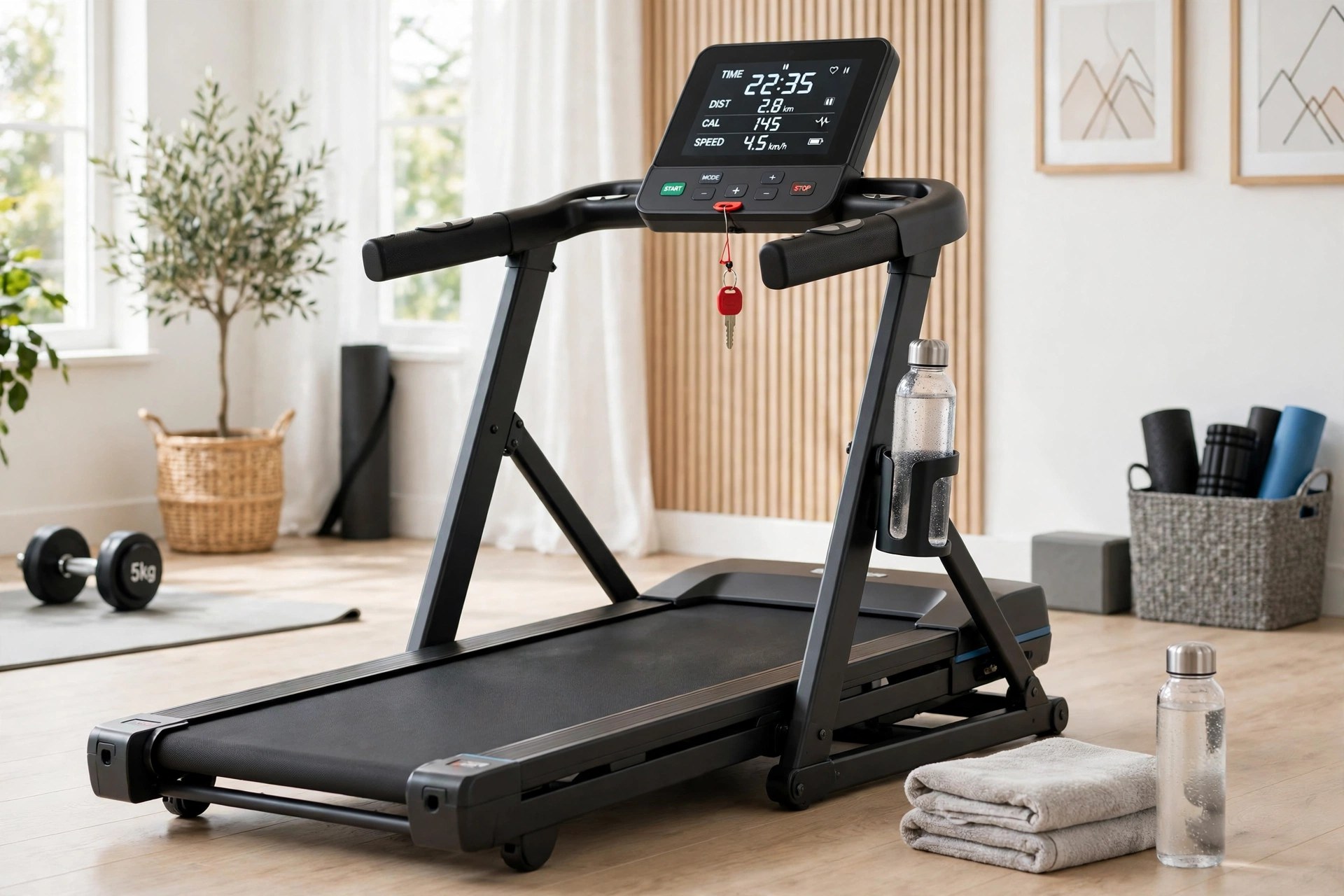
A treadmill is the home gym machine most likely to become a clothes rack — and the reason is almost always fit, not fitness. The wrong treadmill is too big for the room, too loud for the household, or too weak for the runner on it. In 2026 the choice under $1,000 is not about touchscreens or subscriptions; it is about four things: folding vs. fixed, motor size, belt size, and incline. This guide explains those four honestly and picks five treadmills worth buying under $1,000 — from a folding all-rounder to a walking pad to a budget starter.
Last updated: November 6, 2026 · Prices and availability checked November 2026.
Gym Gear Dialed is reader-supported. When you buy through links on our site, we may earn an affiliate commission. Learn more
The four numbers that decide a treadmill
Motor (continuous horsepower): walkers need 2.0, joggers 2.5, runners 3.0 — continuous, not peak. Belt: 20 by 55 inches for runners, 18 by 50 for walkers; taller runners need the 60-inch length. Incline: 10% transforms walking; 15% or more is a serious training tool. Footprint: a full treadmill needs about 7 by 3 feet in use, and a folding one needs a wall that actually fits it folded. Everything else — screen size, speakers, subscription classes — is garnish at this price, and garnish is the first thing to cut when the budget is $1,000.
How we compared them
We compared treadmills on motor size (continuous horsepower, not peak), belt dimensions, incline range, folding vs. fixed frame, weight capacity, noise at walking and running speeds, and owner-reported durability — especially motor and belt longevity under daily use. An honest note: these are researched roundups built from manufacturer specifications and aggregated owner reviews, not instrumented lab tests of every unit. Every claim below is about what a spec means for your room and your training, so you can match the machine to both before ordering.
| Product | Best for | Key spec | Price |
|---|---|---|---|
| Folding treadmill with incline (under $1,000) | Most home gyms | Folding deck · incline · 2.5+ HP motor · 300 lb capacity | Check price → |
| Under-desk walking pad | Small apartments & work-from-home walkers | No handrails · slim profile · stores under a bed · up to ~4 mph | Check price → |
| Non-folding running treadmill (budget running deck) | Regular runners training at home | Fixed deck · 3.0 HP motor · 20x60 belt · 12 mph top speed | Check price → |
| High-incline walking treadmill (steep incline trainer) | Low-impact cardio & weight loss | Up to 20-40% incline · walking speeds · heart-rate programs | Check price → |
| Budget treadmill under $500 | First treadmills & tight budgets | Basic motor · folding · shorter belt · basic console | Check price → |
The five treadmills worth buying under $1,000 in 2026
Folding treadmill with incline (under $1,000) Best overall
The default recommendation under $1,000: a folding treadmill with a real incline and a motor rated at 2.5 continuous horsepower or more. Folding matters because a treadmill is the largest thing most home gyms will ever hold — one that folds up against a wall turns a spare room back into a spare room between workouts, while a non-folding deck permanently claims its floor. Incline matters because it is the cheapest way to make walking hard: a 10% incline at walking pace burns roughly what flat jogging does, without the joint impact of running.
Check three numbers before ordering: the motor's continuous horsepower (not peak — peak is a marketing number, continuous is what the motor sustains), the belt size (at least 20 by 55 inches for runners, 18 by 50 for walkers), and the folded footprint against your actual wall space, including ceiling clearance if it folds upright. A treadmill that fits the room and folds away is the one that gets used; the slightly better machine that blocks a doorway gets sold in six months.
- Folds away — the only treadmill for shared rooms
- Incline makes walking a serious workout without running impact
- Folding decks can feel less planted than fixed decks at a sprint
- Heavier than a walking pad; needs a real delivery plan
Our verdict: Folds away — the only treadmill for shared rooms — the pick for most home gyms.
Best for: most home gyms Not ideal for: folding decks can feel less planted than fixed decks at a sprint
Under-desk walking pad Best for small spaces
If your goal is steps, not sprints, a walking pad is the honest buy: a slim, rail-less treadmill that slides under a standing desk or under a bed, runs quietly at walking speeds, and turns eight hours at a desk into eight thousand steps. It will not replace a runner's treadmill — top speeds around 4 mph and no incline worth mentioning — but for remote workers it solves a problem a full treadmill cannot, because it fits the room you already work in.
The trade-offs are plain: no handrails means no running and no balance support, the belt is shorter than a runner's deck, and the motor is sized for walking, so a heavy user at top speed all day will shorten its life. Buy it when the job is daily movement while working; buy the folding pick above when the job is training. Pair it with the flooring guide if it will sit on hard floors, since a mat keeps it from creeping during long sessions.
- Stores under a bed or desk — smallest footprint here
- Quiet at walking speeds; turns desk hours into steps
- Walking only — no running, no meaningful incline
- Shorter belt and lighter motor than a full treadmill
Our verdict: Stores under a bed or desk — smallest footprint here — the pick for small apartments & work-from-home walkers.
Best for: small apartments & work-from-home walkers Not ideal for: walking only — no running, no meaningful incline
Non-folding running treadmill (budget running deck) Best for runners
Runners should skip the folding compromise and buy a fixed deck: a heavier frame, a longer 60-inch belt, and a 3.0-horsepower continuous motor that does not strain at 10 mph. The fixed frame is the difference between a deck that feels planted at a sprint and one that flexes and creaks, and under $1,000 the way to afford that frame is to give up the folding mechanism and the giant touchscreen — both of which cost more than they return for a runner.
The cost is floor space, permanently: about 7 feet long by 3 feet wide, plus room to step on and off safely. Measure the room, not the product photo. And respect the motor: a runner over 200 pounds on a 2.0-horsepower motor will burn it out, while the same runner on a 3.0-horsepower motor gets years. If running is the job, this is the pick; if walking is the job, the walking pad above costs less and fits better.
- Planted fixed frame and full-length belt for real running
- Motor sized for sustained running, not just walking
- Claims its floor permanently — no folding away
- No touchscreen or subscription content at this price
Our verdict: Planted fixed frame and full-length belt for real running — the pick for regular runners training at home.
Best for: regular runners training at home Not ideal for: claims its floor permanently — no folding away
High-incline walking treadmill (steep incline trainer) Best for low-impact cardio
The steep-incline trainer is the weight-loss pick that does not feel like a punishment: walking at 12-20% incline at 3 mph burns as many calories as flat running for most people, with a fraction of the knee and ankle stress. It is the machine for bad knees, heavy trainees, and anyone who hates running but still wants a hard workout — the incline does the work that speed used to do.
Two honest notes: steep incline walking is harder than it looks, and the first sessions should be short — 15 minutes at a modest incline beats 30 minutes of white-knuckling the rails. And check the incline range honestly: some machines advertise 40% but reach it only in short bursts, while a solid 15% sustained is plenty for most training. If your knees object to running, this machine is the workaround that actually works.
- Serious calorie burn at walking speeds — kind to knees
- Best weight-loss machine here for non-runners
- Steep walking is harder than it sounds at first
- Less useful for runners training for speed
Our verdict: Serious calorie burn at walking speeds — kind to knees — the pick for low-impact cardio & weight loss.
Best for: low-impact cardio & weight loss Not ideal for: steep walking is harder than it sounds at first
Budget treadmill under $500 Best budget
Under $500 you give up the long belt, the big motor, and the incline range, and you keep the one thing that matters: a moving belt you can walk and light-jog on every day, in your own home, whatever the weather. Budget treadmills are the right first machine for anyone unsure a treadmill is their habit — the cost is less than a few months of a gym membership, and the answer to 'will I actually use it' arrives cheaply.
Respect the limits: weight capacities are lower, top speeds and inclines are modest, and the console covers time, distance, speed, and calories rather than training programs. What it is for: daily walking, light jogging, and building the habit — then, if the habit sticks, upgrading to the folding pick with a clear conscience. If it does not stick, you have spent wisely finding out.
- Real home cardio at the lowest price in this guide
- Folding and simple — the right way to test the habit
- Modest motor, belt, and incline — not a runner's machine
- Lighter build; check the weight capacity honestly
Our verdict: Real home cardio at the lowest price in this guide — the pick for first treadmills & tight budgets.
Best for: first treadmills & tight budgets Not ideal for: modest motor, belt, and incline — not a runner's machine
Our verdict
Most people should buy the folding treadmill with incline — it fits the room, folds away, and makes walking hard enough to count. Runners should take the fixed running deck and give up folding for a planted frame. Desk workers get the walking pad, bad knees get the steep-incline trainer, and anyone testing the habit gets the budget treadmill. Whichever you choose, pair it with the rowing machine in our guide for low-impact cross-training and the massage gun for recovery — between treadmill, rower, and recovery, your home conditioning is covered.
Frequently asked questions
How much space does a treadmill really need?
About 7 feet long by 3 feet wide in use for a full-size machine, plus room to step on and off safely behind it. Folding models shrink against a wall between sessions — measure the folded spot, not just the workout spot, and check ceiling height for upright-folding models.
What motor size do I actually need?
Walking: 2.0 continuous horsepower. Jogging: 2.5. Regular running: 3.0. Ignore peak horsepower — it is a brief burst rating, not what the motor sustains for an hour. Heavier users should add half a horsepower to each figure.
Is incline or speed more important for weight loss?
Incline, for most people. Walking uphill burns far more calories than walking flat, without the joint stress of running, and it is sustainable for longer sessions — which is what weight loss actually runs on.
Do I need a subscription for a treadmill?
No. The subscription buys classes and scenery on a screen; the treadmill itself works without it. At under $1,000, spend the money on motor and belt, not on a monthly fee.