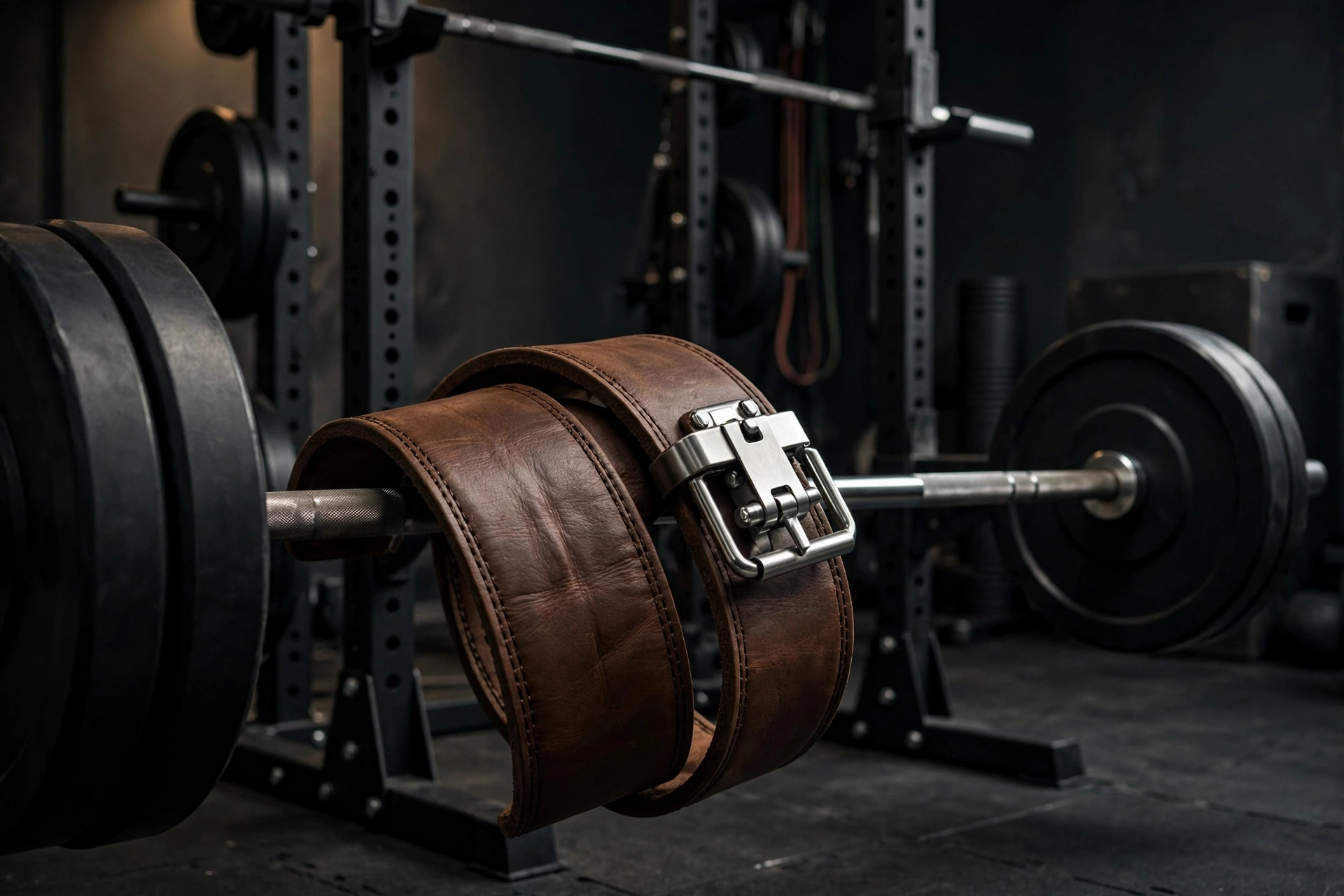
A weightlifting belt does not hold your spine together — your muscles do that. What a belt does is give your abs something rigid to brace against, which raises intra-abdominal pressure and lets you lift heavier with a more stable trunk. Used correctly, it is the cheapest performance gain in strength training: a good belt costs less than a month of most gym memberships and lasts a decade. Used incorrectly — cinched for every set including warm-ups — it becomes a crutch that weakens the core it was meant to support. This guide explains the belt types, the specs that matter, when to wear one and when not to, and the five belts worth buying in 2026.
How a belt actually works (and what it does not do)
When you brace for a heavy squat or deadlift, you take a big breath and push your abs out against your belt — the Valsalva maneuver. The belt resists that outward push, pressure inside your abdomen rises, and your trunk becomes a more rigid column. Studies consistently show this lets lifters move more weight and reduces spinal flexion under load. The key phrase is "push against": a belt you merely tighten does almost nothing. The belt is a wall for your brace, not a corset.
What it does not do: protect a bad brace, replace core training, or make light weights safer. Belts belong on heavy compounds — roughly 80%+ of your max on squats, deadlifts, overhead presses, and rows. Wearing one for curls, lateral raises, and warm-up sets teaches your trunk to outsource stability it should be building itself.
Lever vs. prong vs. quick-release: the closure systems
Lever belts lock with a metal lever that snaps shut — the tightest, most consistent fit, and the fastest on/off between sets. The catch: adjusting the size means unscrewing the lever and moving it, which takes a screwdriver and a minute. If your waist size is stable and you want maximum tightness, lever wins.
Single-prong belts work like a regular belt buckle with holes every inch or so. Easier to adjust than a lever — just use a different hole — and the classic choice for lifters whose weight fluctuates. Slightly slower to get competition-tight, and the prong can dig if the belt is cheap.
Quick-release / Velcro nylon belts use a roller buckle or Velcro on a flexible nylon body. Infinitely adjustable, light, and comfortable — the choice for CrossFit-style training, Olympic lifting, and anyone who wants support without rigidity. They do not provide the same rock-solid brace as leather, and Velcro wears out eventually, but for dynamic training they are the right tool.
10mm vs. 13mm, and the width question
Belt thickness is measured in millimeters of leather. 10mm is the sweet spot for most home-gym lifters: stiff enough for heavy squats and deadlifts, broken in within a few weeks, comfortable enough to wear for a full session. 13mm is the competition standard — maximally rigid, brutally stiff for the first month, and the choice for powerlifters chasing every pound. If you are not competing, 10mm is the honest answer; 13mm is for people who already know they want 13mm.
Width: powerlifting belts are a uniform 4 inches all around — maximum surface for bracing. Tapered belts (wide in back, narrow in front) are the Olympic-lifting style, allowing more torso flexion for cleans and snatches. For general home-gym strength training, the uniform 4-inch belt is the default.
How we compared them
We compared belt categories on the specs that decide a decade of ownership: leather quality and layer construction (single-piece vs. laminated), buckle and lever hardware quality, stitching and edge finishing, the break-in period owners report, sizing accuracy and range, and warranty. We weighted hardware durability and honest sizing heavily — a belt that does not fit is a wall decoration.
An honest note: these are researched roundups built from manufacturer specifications, powerlifting equipment guides, and aggregated owner reviews — not hands-on load testing of every belt. Every claim below is about what a belt category does and how to choose within it, so you can match the belt to your training.
The five weightlifting belts worth buying in 2026
10mm lever belt — the home-gym default
If you buy one belt, buy this: 10mm leather, lever closure, uniform 4-inch width. It is stiff enough for the heaviest squats and deadlifts a home gym will see, breaks in within a few weeks of regular use, and the lever gives you the same competition-tight fit every single set. This is the belt category most experienced home-gym lifters end up with, usually after trying something cheaper first.
Size it carefully — lever belts adjust in coarse steps, so measure your waist at the navel (where the belt sits, not your pants size) and follow the maker's chart exactly. Between sizes, size up; a lever moved to its last hole has no room left.
- Pros: the best brace-per-dollar in strength training; consistent tightness every set
- Pros: 10mm breaks in fast and suits non-competitors; lasts a decade or more
- Cons: lever adjustment needs a screwdriver — not a between-sets change
- Cons: coarse sizing steps — measure at the navel and follow the chart
13mm lever belt — the competition-grade option
The powerlifting standard: 13mm of leather, lever closure, zero flex. For maximal squats and deadlifts it provides the most rigid brace money can buy, which is why it dominates competition platforms. The price is a brutal break-in — expect a month of stiffness before it molds to your torso — and overkill for anyone not pushing near-maximal loads.
Buy this if you compete, plan to compete, or simply want the stiffest belt available and accept the break-in as the cost. Everyone else gets 95% of the benefit from the 10mm above with far less suffering.
- Pros: the stiffest, most supportive belt category made; competition-legal everywhere
- Pros: lever gives repeatable max tightness; effectively indestructible
- Cons: brutal month-long break-in; uncomfortable until it molds to you
- Cons: overkill for general training — honest overkill, but overkill
Single-prong leather belt — the adjustable classic
The prong belt is the choice for lifters whose waistline moves — bulking, cutting, or just preferring different tightness for squats vs. deadlifts. Holes every inch give you fine control with no tools, and a good single-prong belt braces nearly as hard as a lever. It is also the easiest belt to share in a household gym, since adjustment takes two seconds.
The trade-off is speed and absolute tightness: getting a prong belt competition-tight takes effort and a practiced yank, and the prong hardware is the wear point to inspect in reviews. For most home lifters, though, the adjustability is worth more than the last 2% of tightness.
- Pros: tool-free adjustment in 1-inch steps — ideal for fluctuating weight
- Pros: nearly lever-level bracing; easy to share in a household gym
- Cons: slower to get maximally tight than a lever; prong is the wear point
- Cons: double-prong versions exist but add hassle for no real benefit — stick to single
Nylon quick-release belt — for dynamic training
Not every session is heavy squats. For CrossFit-style WODs, Olympic lifting, and circuits where you transition fast, a nylon belt with a quick-release buckle gives you support without the rigidity — and you can loosen it between movements in one motion. It is lighter, cheaper, packs flat in a gym bag, and comfortable enough to wear for an entire workout.
Understand what it is not: a nylon belt will never brace like 10mm of leather. If your training is heavy barbell compounds, this is the wrong belt. If your training is varied and fast, it is the right one — match the belt to the training, not the other way around.
- Pros: infinitely adjustable; light, packable, comfortable for full workouts
- Pros: quick-release is genuinely fast between movements; budget-friendly
- Cons: less rigid bracing than leather — not for maximal squats and deadlifts
- Cons: Velcro/roller hardware wears over time — check closure reviews
Dip belt — the bodyweight-loading specialist
A different job entirely: a dip belt hangs plates from your waist for weighted dips and pull-ups, the two best upper-body builders a home gym offers. A wide, padded waist strap with a long chain (36 inches minimum — short chains do not fit around big plates) turns bodyweight movements into progressive strength work. If your home gym has a power rack with a pull-up bar, this is the cheapest way to keep progressing once bodyweight gets easy.
Do not confuse it with a lifting belt — it provides no trunk support and is not worn for squats. It is a loading tool, and a simple, well-made one lasts forever because there is almost nothing to break.
- Pros: the cheapest progressive overload for dips and pull-ups; nearly indestructible
- Pros: long chain fits big plates; padded strap stays comfortable under load
- Cons: single-purpose — it is a loading tool, not a support belt
- Cons: short-chain versions are frustrating — verify 30"+ chain length
Our verdict
For heavy home-gym barbell training, buy a 10mm lever belt — it is the category most lifters should have bought first, and the one they end up with after the cheap belt experiment. If your weight fluctuates or you share the gym, the single-prong belt trades a little tightness for real adjustability. Trainers doing fast, varied work should get the nylon quick-release instead of (or alongside) leather. The 13mm lever is for competitors and the committed; the dip belt is for anyone whose pull-ups got too easy.
Whatever you buy, remember the rule that matters more than the belt: wear it for heavy compounds, take it off for everything else. The belt supports the brace — it is not the brace.
Breaking in a leather belt without hating it
A new leather belt — especially 13mm — arrives feeling like armor plating. The break-in is simple but not instant: roll it tightly and unroll it a dozen times, wear it around the house for an evening, and use it for your working sets (not warm-ups) for the first few weeks. Never soak it, never bake it, never oil it aggressively — leather breaks in through flexing, and shortcuts crack it.
Sizing deserves a second mention because it is the #1 belt-buying mistake. Measure your waist at the navel with a tape, relaxed, where the belt will actually sit — not your jeans size, which can be inches off. If you are between sizes on a lever belt, go up; on a prong belt, either way works since the holes cover the gap. And re-measure if your weight changes significantly — a belt that fit at 200 lb is a different belt at 180.
Frequently asked questions
At what weight should I start using a belt?
There is no number — it is about effort. When your heavy working sets (roughly 80%+ of max) feel limited by trunk stability rather than the prime movers, a belt helps. Beginners should learn to brace without one first; the belt amplifies a good brace, it does not create one.
Will a belt weaken my core?
Only if you wear it for everything. Used for heavy compounds and removed for warm-ups and accessories, research shows core activation stays high — the belt changes trunk mechanics, it does not switch your abs off. The people with weak cores and belts are the ones who never take them off.
Lever or prong for a first belt?
Lever if your waist is stable and you want maximum tightness with zero fuss; prong if your weight fluctuates, you share the belt, or you want different tightness for different lifts. Both are correct — it is a lifestyle question, not a quality question.
Can I use a weightlifting belt for CrossFit-style workouts?
A stiff leather belt slows you down in fast workouts — that is what the nylon quick-release category is for. Many hybrid trainers own both: leather for strength days, nylon for conditioning days.