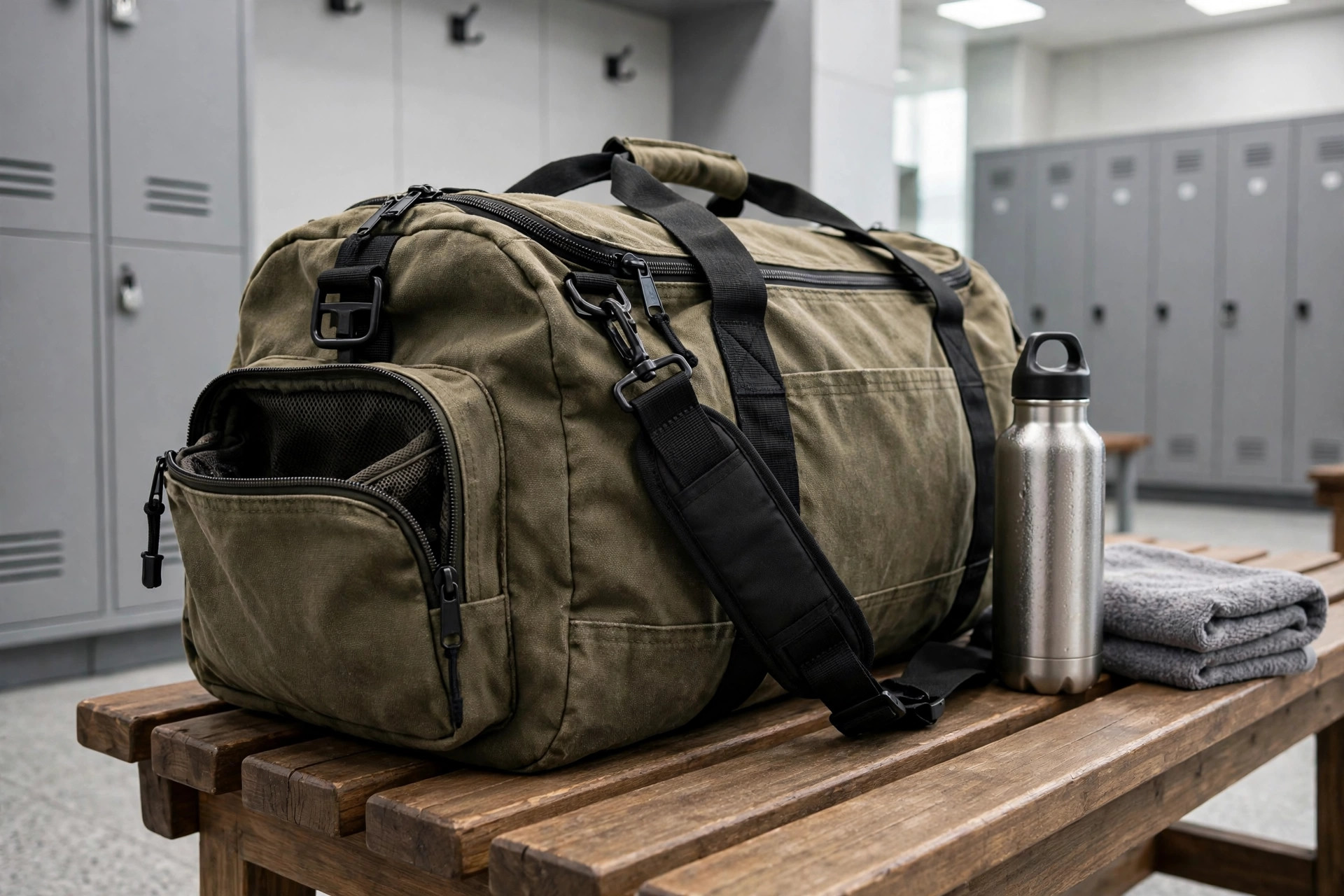
A gym bag is the least glamorous purchase in your training life and one of the most-used: it gets thrown in trunks, dragged across locker room floors, and stuffed with sweaty gear five days a week. The difference between a good duffel and a bad one is not style — it is whether the zippers still work in year three, whether your shoes stink up your clothes, and whether the thing fits in a standard gym locker. This guide covers honest sizing, the features that actually matter, the materials that survive, and the five duffels worth buying in 2026.
What size duffel do you actually need?
Duffels are measured in liters, and the numbers lie a little — a 40L bag from one brand holds what another calls 50L. Use these as honest ranges. 25–30L (small): shoes, a change of clothes, earbuds, and a water bottle — perfect if you train near home and do not shower at the gym. 35–45L (medium): the sweet spot for most lifters — adds room for a belt, wraps, a towel, and shower gear. 50–60L (large/weekender): for the full kit plus travel — doubles as an overnight bag, but check that it fits your gym's lockers before committing.
The most common mistake is buying too big. An oversized duffel becomes a black hole where gear migrates to the bottom and small items vanish. If you are unsure, go one size smaller than your instinct — a packed-but-organized medium bag beats a half-empty large one every time.
The features that actually matter
Separate shoe compartment: the single most important feature. Shoes are the smelliest, dirtiest thing you carry, and a vented side pocket keeps them off your clean clothes. Non-negotiable. Ventilation: mesh panels or grommets in the shoe pocket and main compartment let moisture escape — a sealed bag marinates your gear in sweat.
Zippers: the #1 failure point on cheap bags. Look for chunky, name-brand-style zippers (YKK or equivalent) with large pulls you can grab with lifting hands. Material: ballistic nylon and heavy canvas survive years of abuse; thin polyester tears at the stress points within a year of daily use. Carry options: a padded, detachable shoulder strap plus grab handles — backpack straps are a bonus for bike commuters, not a necessity for drivers.
Wet/dry pocket: a waterproof-lined pouch for the sweaty shirt and towel separates the nasty from the clean without a plastic bag. Small feature, daily payoff.
How we compared them
We compared duffel categories on the specs that decide years of daily use: stated vs. usable capacity, shoe compartment design and ventilation, zipper and hardware quality, fabric denier and water resistance, strap comfort under load, and warranty. We weighted zipper quality and the shoe compartment above all — those are the two things owners complain about when they get them wrong.
An honest note: these are researched roundups built from manufacturer specifications, materials knowledge, and aggregated owner reviews — not hands-on abuse testing of every bag. The picks below are the categories whose owners report the longest happy service, so you can verify current reviews before you buy.
The five gym duffels worth buying in 2026
40L duffel with shoe compartment — the everyday standard
The default gym bag: roughly 40 liters, a vented side shoe pocket, a wet/dry pouch, and a shoulder strap. It swallows a belt, wraps, shoes, a full change of clothes, and shower gear without becoming luggage. This is the category to buy if you train regularly and want one bag that does everything — the vast majority of lifters never need anything else.
When comparing options in this category, prioritize zipper quality and the shoe pocket's ventilation over extra pockets and styling. A 40L bag lives or dies on its hardware, and the price difference between decent zippers and great ones is smaller than the cost of replacing a dead bag.
- Pros: the right size for full training kits; vented shoe pocket keeps gear separated
- Pros: fits standard gym lockers; doubles for short trips
- Cons: overkill if you train at home and just need a carry bag
- Cons: quality varies hugely at this size — cheap ones die at the zippers
Waterproof duffel — for wet climates and outdoor training
Standard duffels resist a splash; waterproof duffels (welded seams, roll-top or waterproof zippers) survive being left in rain, thrown in a truck bed, or carried through a downpour to an outdoor session. If you train outdoors, bike-commute in all weather, or live somewhere the sky opens without warning, this is the upgrade that protects everything inside.
The trade-off is organization: waterproof construction means fewer pockets and compartments, since every opening is a leak path. It is a drier, simpler bag — buy it for the weather protection, not the pocket count.
- Pros: genuinely weatherproof — rain, truck beds, and wet ground are non-issues
- Pros: welded construction is inherently tougher than stitched
- Cons: fewer pockets and compartments than standard duffels
- Cons: heavier and stiffer; overkill for car-to-locker training
Convertible duffel-backpack — for commuters
A duffel with stowable backpack straps: carry it as a duffel from the car, wear it as a backpack on the bike or the walk from the train. For commuters this is the only category that makes sense — a shoulder-strap duffel sliding off on a bike is miserable, and a pure backpack rarely has the shoe compartment and wide opening that make duffels easy to pack.
Check the strap quality carefully in reviews: convertible straps are the weak point of the category, and cheap ones dig into shoulders under a loaded bag. The best versions hide the straps in a zippered panel so they never snag in transit.
- Pros: the only sane option for bike and transit commuters; duffel packing convenience
- Pros: stowable straps keep the duffel clean when you are not wearing it
- Cons: straps are the weak point — cheap versions are uncomfortable loaded
- Cons: slightly heavier and pricier than a plain duffel of the same size
Small 25L duffel — the minimalist's bag
For the lifter who trains at home or nearby and does not shower at the gym: shoes, clothes, belt, bottle, done. A small duffel forces the discipline the big bags lack — everything has a place because there is no room for chaos. It fits in the smallest lockers, the smallest trunks, and overhead bins without a fight.
The obvious limit is capacity: add shower gear or a second pair of shoes and you are done. Buy this when you know your kit is small and stable, not when you are hoping it will stay that way.
- Pros: forces organization; fits anywhere — small lockers, trunks, overhead bins
- Pros: lighter and cheaper than full-size duffels; faster to pack and unpack
- Cons: no room to grow — one added item category and it is full
- Cons: shoe compartments are tighter; bulky lifting shoes may not fit
Weekender duffel — the gym bag that travels
The 50L+ duffel that does double duty: full gym kit on weekdays, carry-on for weekend trips. A good weekender has the shoe compartment and wet/dry pocket of a gym bag plus the structure and carry comfort of travel luggage. If you travel for work or competitions and hate owning single-purpose gear, consolidating into one bag is genuinely satisfying.
The compromise is daily bulk: a weekender is bigger than you need for a normal session, and half-empty bags pack badly. This is the right buy for the traveler who trains, not the trainer who occasionally travels.
- Pros: one bag for gym and travel — less gear to own and store
- Pros: carry-on compliant sizes available; structured enough for travel
- Cons: oversized for daily gym use — packs badly when half empty
- Cons: check airline carry-on dimensions before buying; not all "weekenders" qualify
Our verdict
Most lifters should buy the 40L duffel with a vented shoe compartment and stop thinking about it — it is the right size, the right feature set, and the category with the deepest bench of proven options. Commuters need the convertible duffel-backpack; outdoor and all-weather trainers need the waterproof duffel. Minimalists with a stable kit will love the 25L, and frequent travelers should consolidate into the weekender.
Whatever size you choose, spend the extra few dollars for the version with better zippers — it is the difference between a three-year bag and a ten-year bag, and you will touch those zippers a thousand times.
Keeping it from smelling like a locker room
The bag is only half the equation; the other half is what you do after training. Unpack sweaty gear the same day — a bag left zipped with wet clothes becomes a biology experiment by morning. The vented shoe compartment helps only if air actually reaches it, so leave the bag open at home. Wash the bag itself quarterly: most duffels survive a gentle machine wash (air dry, never the dryer — heat kills waterproof coatings and melts cheap hardware).
Two cheap additions punch above their weight: a packing checklist taped inside the lid until the routine is automatic, and a small mesh laundry pouch for the sweaty items — it contains the mess and goes straight into the washing machine. Your nose, your car, and your training partners will all notice the difference.
Frequently asked questions
Duffel or backpack for the gym?
Duffel for most people — the wide opening makes packing faster and the shoe compartment designs are better. Backpack only if you commute by bike or on foot, in which case get the convertible that does both. See our duffel vs. backpack comparison for the full breakdown.
What size fits in a standard gym locker?
A 40L duffel fits the standard 12-inch gym locker; 50L+ bags often do not, or fit only by force. If your gym has small lockers, measure before buying large — or embrace the 25L minimalist bag.
How do I wash a gym duffel?
Empty every pocket, gentle cycle with mild detergent, air dry completely. Never machine-dry — heat destroys waterproof coatings and warps zippers. For smell between washes, a sprinkle of baking soda left overnight works.
Are expensive duffels actually better?
Up to a point: the jump from a bargain bag to a mid-range one buys real zipper and fabric quality that lasts years longer. Past that, you are paying for brand and styling. The sweet spot is the mid-range bag with proven hardware — that is where the ten-year bags live.