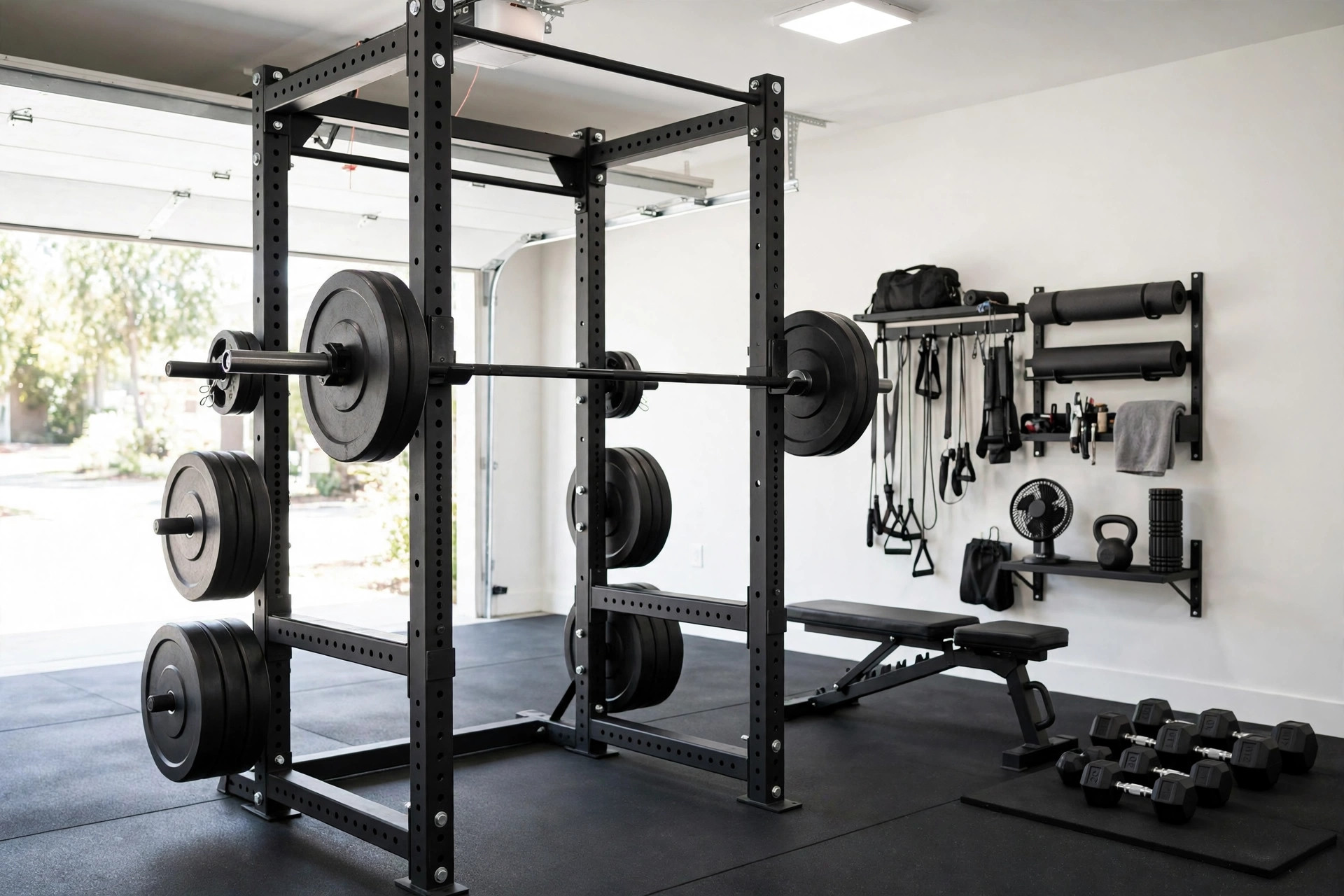
The squat rack is the spine of a home gym: every barbell lift you care about — squat, bench, press, rack pull — happens inside it or against it, and it is the one piece of equipment that decides whether training alone at home is safe. The wrong rack is too big for the room, too weak for the lifter on it, or too wobbly to trust under a heavy bar. In 2026 the choice is not about brand badges; it is about four things: footprint, weight capacity, steel and hole spacing, and the safety system. This guide explains those four honestly and picks five squat racks worth buying — from a full power rack to a folding wall rack to a budget starter.
Last updated: November 10, 2026 · Prices and availability checked November 2026.
Gym Gear Dialed is reader-supported. When you buy through links on our site, we may earn an affiliate commission. Learn more
The four numbers that decide a squat rack
Footprint: a full rack needs about 4 by 4 feet plus barbell overhang; a half rack needs about two-thirds of that; stands and folding racks need almost none when stored. Weight capacity: buy a rack rated comfortably above your heaviest working set, not at it — a 1,000-pound rack for a 400-pound squatter is not overkill, it is headroom. Steel and hole spacing: 11-gauge steel with 1-inch spacing through the bench zone is the quality mark; thinner steel and 2-inch spacing are the budget tells. Safety system: safety bars or arms that catch a failed rep are not an accessory — for anyone training alone, they are the purchase. Everything else — pull-up bars, dip handles, plate storage, color — is useful garnish, and garnish is the first thing to cut when the budget is tight.
Full rack vs. half rack vs. stands: which type is yours?
The product-vs-product question that decides most purchases. A full power rack is the training room: safest, most versatile, biggest. A half rack is the compromise for smaller rooms: same barbell work, open front, less stability at the top end. Squat stands are the portable minimum: cheapest and storable, but no cage and no forgiveness. A folding wall rack is the garage solution: full-rack training that disappears. The honest way to choose is to start from the room and the lifter, not the catalog: measure the floor and the ceiling, write down your heaviest working set, and ask whether anyone else uses the room. The rack that fits the room and the lifter is the one that gets used; the slightly better rack that blocks a doorway or scares you under a heavy bar gets sold in six months.
How we compared them
We compared racks on footprint in use and in storage, rated weight capacity against real working loads, steel gauge and upright hole spacing, the safety system (bars vs. arms vs. none), stability under heavy re-racks, and owner-reported durability — especially weld quality and whether the rack stays planted over years of use. An honest note: these are researched roundups built from manufacturer specifications and aggregated owner reviews, not instrumented load tests of every frame. Every claim below is about what a spec means for your room and your lifts, so you can match the rack to both before ordering.
| Product | Best for | Key spec | Price |
|---|---|---|---|
| Full power rack (4-post) | Most home gyms | 4-post steel frame · 1,000 lb capacity · safety bars · pull-up bar | Check price → |
| Half rack (2-post open frame) | Smaller home gyms & garage corners | 2-post open frame · smaller footprint · safety arms · plate storage | Check price → |
| Standalone squat stands (pair) | Renters & lifters who need to move the rack | Two independent stands · adjustable height · stores in a closet · ~600 lb capacity | Check price → |
| Folding wall-mounted rack | Garages & multi-use rooms | Folds flat to the wall · ~6 inches deep folded · 1,000 lb capacity | Check price → |
| Budget squat rack under $300 | First racks & tight budgets | Basic steel rack · ~500 lb capacity · safety bars included | Check price → |
The five squat racks worth buying in 2026
Full power rack (4-post) Best overall
The default recommendation: a full four-post power rack. Four uprights, a pair of safety bars, a pull-up bar across the top, and room to squat, bench, press, and do pull-ups inside one frame. The safety bars are the reason to buy it: squatting alone at home is safe only when a failed rep has somewhere to go, and a power rack gives a missed squat a pair of steel bars to land on instead of your back. That single feature turns a home gym from a calculated risk into a training room you can use hard, alone, every day.
Check three numbers before ordering: the footprint (about 4 by 4 feet for the frame, plus the length of your barbell sticking out either side), the ceiling height (you need headroom above the pull-up bar, not just above the rack), and the steel and hole spacing (11-gauge steel and 1-inch hole spacing through the bench zone is the quality mark; wider spacing is fine for squats and less ideal for benching). Pair it with the bumper plates in our guide — bumper plates survive being dropped onto the safety bars, iron plates do not, and the rack is where drops happen.
- Safest way to squat alone — safety bars catch a failed rep
- Pull-up bar, dips, and plate storage in one frame
- Largest footprint here — needs a dedicated corner
- Heavy and semi-permanent once bolted down
Our verdict: Safest way to squat alone — safety bars catch a failed rep — the pick for most home gyms.
Best for: most home gyms Not ideal for: largest footprint here — needs a dedicated corner
Half rack (2-post open frame) Best for smaller rooms
A half rack keeps the two uprights and the safety arms and drops the rear posts, which cuts the footprint by roughly a third and opens the front of the rack completely. You walk in, unrack, squat, and walk out without ever stepping through a cage — and for lifters who also do barbell rows, cleans, and overhead work in front of the rack, that open front is genuinely better than a cage. The safety arms still catch a failed squat, so the core safety story survives the smaller frame.
The trade is stability: two posts cannot match four for rigidity, especially on heavy rack pulls or when the bar is re-racked hard to one side. Most half racks expect to be bolted to the floor or ballasted with plates on the storage pegs, and that is not a flaw — it is the deal. If your working squat is under about 400 pounds and your floor space is tight, the half rack is the honest pick; if you are chasing heavy singles, the full rack above earns its floor. Either way, protect the floor underneath with the flooring from our guide, since a half rack that shifts even slightly will mark concrete and chew rubber.
- Fits a garage corner a full rack cannot
- Open front makes walk-outs and bar work easy
- Less planted than a 4-post rack at heavy loads
- Usually needs bolting down or loaded storage pegs for stability
Our verdict: Fits a garage corner a full rack cannot — the pick for smaller home gyms & garage corners.
Best for: smaller home gyms & garage corners Not ideal for: less planted than a 4-post rack at heavy loads
Standalone squat stands (pair) Best for portability
Two independent stands are the cheapest way to squat with a barbell at home, and the only rack in this guide that disappears: break them down and they lean in a closet, which makes them the renter's rack and the only honest option for a room that must be something else by evening. Each stand adjusts for height, the better ones have spotter arms, and a pair costs less than a single month of many gym memberships — the entry price for barbell training at home is genuinely low.
Know the limits cold: stands have no cage, so a failed rep without spotter arms has nowhere safe to go, and the two stands are independent, which means a bar racked unevenly can tip one of them. Never squat heavy alone on stands without spotter arms, always set both stands to the same height, and step back from the stands rather than walking the bar forward into them. Used with that discipline, stands are a real training tool, not a compromise — and they pair naturally with the adjustable dumbbells in our guide for the accessory work a rack cannot do.
- Cheapest way to squat with a barbell at home
- Breaks down and stores — the renter's rack
- No built-in safety cage — spotter arms are essential
- Can tip if a bar is racked unevenly
Our verdict: Cheapest way to squat with a barbell at home — the pick for renters & lifters who need to move the rack.
Best for: renters & lifters who need to move the rack Not ideal for: no built-in safety cage — spotter arms are essential
Folding wall-mounted rack Best for garages & shared spaces
The folding wall-mounted rack is the garage owner's answer to the footprint problem: unfolded it is a full rack with safety arms and a pull-up bar, and folded it sits about six inches deep against the wall, so the car goes back in the garage between sessions. It is the only rack here that lets a shared space stay shared — the workout happens, the rack folds away, and the room is a garage again in under a minute.
The installation is the whole job, and it is not optional or casual: the rack must lag-bolt into wall studs or concrete, never into drywall alone, and the wall must actually be sound. Check your stud spacing and wall construction before ordering, and budget an hour and a friend for the install. Once it is up, it is as solid as a freestanding rack — and the flooring under it still matters, since the bar drops in the same place every session and a bare concrete floor will not forgive it.
- Folds to about 6 inches deep — the garage stays a garage
- Full safety arms when unfolded, like a power rack
- Installation means lag bolts into studs — not a renter's rack
- Fold and unfold adds a minute to every session
Our verdict: Folds to about 6 inches deep — the garage stays a garage — the pick for garages & multi-use rooms.
Best for: garages & multi-use rooms Not ideal for: installation means lag bolts into studs — not a renter's rack
Budget squat rack under $300 Best budget
Under $300 buys a real squat rack with safety bars — thinner steel, wider hole spacing, and a lower weight capacity than the premium frames, but a rack that holds a barbell, catches a failed rep, and lets a beginner train the big lifts at home for less than a few months of gym dues. For a first rack, that is the right trade: the capacity is honest for most lifters' first years, and the money saved goes to the barbell and plates that actually determine the training.
Check the capacity honestly against your lifts, not your hopes — a rack rated at 500 pounds is a 500-pound rack, and a lifter squatting 400 should not buy it. Check the hole spacing too: two-inch spacing is fine for squats and workable for bench, but you will notice it when a bench height falls between holes. And inspect the welds and bolts on arrival; budget racks are where quality control varies most. If the habit sticks, upgrade to the full rack above with a clear conscience; if it does not, you found out cheaply.
- A real rack with safeties at the lowest price here
- Enough capacity for most lifters' first years
- Thinner steel and wider hole spacing than premium racks
- Lower capacity — check it honestly against your lifts
Our verdict: A real rack with safeties at the lowest price here — the pick for first racks & tight budgets.
Best for: first racks & tight budgets Not ideal for: thinner steel and wider hole spacing than premium racks
Our verdict
Most people should buy the full power rack — it is the safest way to train alone, and the frame everything else in the gym hangs off. Smaller rooms get the half rack, renters and movers get the squat stands, garage owners get the folding wall rack, and anyone testing the habit gets the budget rack. Whichever you choose, round out the setup with the adjustable dumbbells in our guide for accessory work and the massage gun for recovery — rack, dumbbells, and recovery cover the home strength program end to end.
Frequently asked questions
How much space does a squat rack need?
A full rack needs about 4 by 4 feet for the frame, plus the barbell overhang on either side and room to load plates and step back. A half rack needs about two-thirds of that. Stands need only the barbell's footprint while in use and almost nothing stored; a folding rack needs wall space and about six inches of depth when folded.
What weight capacity do I actually need?
A rack rated at least 50% above your heaviest working set. If you squat 300 pounds, a 500-pound rating is the floor, not the target — and the rating should cover the bar dropping onto the safeties, not just resting on the J-hooks.
Do I need to bolt a squat rack to the floor?
Full racks usually stand fine unbolted on rubber flooring; half racks and folding racks generally need bolting or ballast. If the rack wobbles when you re-rack hard, bolt it — a rack that moves under the bar is a rack you will stop trusting.
Can I squat safely alone at home?
Yes, with safety bars or arms set just below your lowest squat depth, and only inside a rack that has them. Never squat heavy alone on bare stands without spotter arms, and never rely on bailing backward — set the safeties, test them with an empty bar, and train inside them.